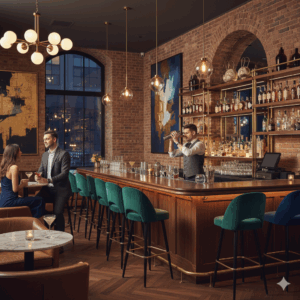
In simple terms, Ginza bars are built around controlled comfort: soft lighting, clear entry/exit flow, and seating that puts you close to the bartender or your group. Many places are “counter-first,” meaning the main experience is a short conversation, a tailored drink, and a steady rhythm rather than loud standing crowds.
The “service” is not only the drink. In Ginza, the bartender often performs a structured kind of hospitality: you describe your taste (sweet/dry, citrus/woody, light/strong), and they translate that into a cocktail with careful temperature, dilution, and garnish. This is a form of urban craft culture—an evening ritual where small gestures (ice handling, glass choice, timing) signal respect and skill.
You will also see Japan-specific pricing habits, especially the cover charge (seat charge). Sometimes it includes a small welcome dish (“otoshi”), which turns the first minutes into a guided start. Ginza’s nightlife is often about “institutionalized intimacy”: a safe, predictable format for closeness—talking at the counter, being remembered, and being served in a calm, formal way—without needing long explanations.
Quick mindset: In Ginza, you pay for the seat, the pace, and the craft—not just the liquid in the glass.
Table of Contents
1. Where should you start in Ginza bars?
2. How do you access top areas for Ginza bars?
3. What prices, time, and eligibility should you expect?
4. Which venue types and services fit your night?
5. How do reservations, etiquette & useful phrases work?
1. Where should you start in Ginza bars?
1-1. What makes Ginza’s bar culture distinct?
Ginza is not “party nightlife.” It is closer to a craft workshop with a social edge. The room is usually quiet enough to speak at normal volume. The bartender is a central figure, and the counter is the stage: hands, tools, ice, and glass become a visible performance. This is why even small bars can feel “luxury” without being huge.
If you want a fast overview of how Ginza itself frames the bar scene, the Ginza area’s official site curates a bar list and also explains the local idea of a cover charge (seat charge). That explanation is a useful “decoder” for first-timers:
GINZA OFFICIAL: recommended Ginza bars and cover-charge note (Japanese).
Tip: Your first order can be “a direction,” not a specific drink. For example: “something light and citrusy” or “a whisky-based drink, not too sweet.”
1-2. A typical first visit flow (what happens in the first 5 minutes)
Many Ginza bars follow a calm sequence: greeting → seating → quick check of rules (smoking, last order, cover charge) → first drink order. The pace is designed to remove uncertainty. When you sit, you are “entering the format,” and the format is what makes Ginza comfortable for visitors who want a predictable, polite night.
A well-known example is a stated cover charge with a defined service style. For instance, TANAGOKORO THE BAR clearly lists a cover charge and operating hours on its official site:
plan for ¥1,500 as a cover charge plus 10% consumption tax, and note their listed hours 17:00–25:00.
Source: TANAGOKORO THE BAR official website (Japanese).
1-3. What “cover charge” means in Ginza (and why it exists)
In Ginza, the cover charge is usually a seat fee, sometimes paired with a small welcome item. The point is cultural and practical: it supports a slower pace, staffing, and the quality of the room. Ginza’s official site describes the cover charge as a Japan-specific system and notes that some places include “otoshi.” It also notes that high-end bars may charge from ¥1,000 and up, while some places are no-charge. Source:
GINZA OFFICIAL cover-charge explanation (Japanese).
Notice: If you want to avoid surprises, ask about the cover charge before ordering. In Ginza, that question is normal and polite.
2. How do you access top areas for Ginza bars?
2-1. The core stations: Ginza, Yurakucho, Shimbashi
The Ginza area is walkable, but your station choice changes your first impression.
Ginza Station drops you into the “main streets” feeling; Yurakucho is great for JR transfers; Shimbashi often connects to late-night food-and-drink lanes.
If you want official station-level orientation, start with Tokyo Metro’s Ginza Station maps (they list exits and nearby buildings):
Tokyo Metro Ginza Station yard map (Japanese).
For JR access, JR East provides official station information for Yurakucho:
JR East Yurakucho Station information (Japanese).
2-2. Key micro-areas: Namiki-dori, Ginza 6-chome, Corridor-gai
Ginza “feels” like several small worlds stitched together. Namiki-dori is a classic nightlife spine. Ginza 6-chome is dense with shops, dining, and bars. Corridor-gai (the corridor area) is known for bar hopping and late-night energy.
For a clean walking anchor with official times, GINZA SIX publishes detailed access times from major stations. For example, they list 2 minutes from Ginza Station A3, 3 minutes from Higashi-Ginza Station A1, and 10 minutes from Yurakucho Station Ginza Exit. Source:
GINZA SIX access page (Japanese).
Corridor-gai’s bar-hopping concept is also explicitly framed by a major local property: The Royal Park Canvas Ginza Corridor positions itself as a “nightlife gateway” and highlights “bar hopping” as a theme. Source:
The Royal Park Canvas Ginza Corridor official website (Japanese).
2-3. A simple first-night route (low stress, high payoff)
Here is a practical “first night” plan:
start near Ginza Station (easy navigation), pick one bar with clear listed rules, then move toward Corridor-gai if you want more movement and music.
The goal is to learn the format early, then choose your vibe.
Table 2: Access & Hours
| Station / Anchor | Walk Time | Hours (example) | Area (JP Link) |
|---|---|---|---|
| GINZA SIX (central anchor) | 2 min from Ginza Sta. A3 / 10 min from Yurakucho | Facility hours listed as 10:30–20:30 | Official website (Japanese) |
| CANVAS LOUNGE (Corridor-gai gateway) | Near Ginza corridor area; open info on site | Mon–Sat 11:00–28:00 / Sun & holidays 11:00–22:00 | Official website (Japanese) |
| GINZA MUSIC BAR (music-focused stop) | From Shimbashi 4 min / from Ginza Sta. 6 min | Hours vary; check before you go | Official website (Japanese) |
Notes: Walk times and example hours are taken from each venue’s official access / facility pages. Always re-check the official page on the day you visit.
3. What prices, time, and eligibility should you expect?
3-1. Cover charge + drink prices (real examples)
The clearest way to budget is to use bars that publish their numbers.
For example, TANAGOKORO THE BAR lists a cover charge of ¥1,500 plus 10% tax on its official site:
TANAGOKORO THE BAR official website (Japanese).
Another example: LITTLE SMITH states a cover charge of ¥1,650 (including seat fee + onion soup + appetizer) on its official site:
LITTLE SMITH official website (Japanese).
If you want a lounge-style spot with published late hours, CANVAS LOUNGE lists operating hours up to 28:00 on certain days and also notes age-related alcohol service restrictions on the official page:
CANVAS LOUNGE official page (Japanese).
3-2. Time planning: how long to stay, and when to move
A Ginza bar visit is often “short and focused.” Many people treat each stop as 1–2 drinks plus a short talk. If you want to bar-hop, decide your end time first, then work backwards:
2 stops = about 2–3 hours,
3 stops = about 3–4.5 hours.
(This is a practical planning rule; exact time varies by queue, conversation, and last-order timing.)
Tip: If a place feels perfect, stay. Ginza rewards “one excellent stop” more than “many rushed stops.”
3-3. Eligibility and basic rules (age and venue policies)
In Japan, alcohol service is for adults. Some official venue pages explicitly mention this. For example, CANVAS LOUNGE notes that alcohol will not be served to guests under 20 on its official page:
CANVAS LOUNGE official page (Japanese).
Smoking policies vary by venue. Some bars clearly state “non-smoking” on their official sites (for example, TANAGOKORO THE BAR notes all seats are non-smoking on its page):
TANAGOKORO THE BAR official website (Japanese).
Others may allow smoking in certain formats; always confirm at the door.
Table 1: Venue Types & Base Fees
| Venue Type | Typical Fee | Session Time | Area (JP Link) |
|---|---|---|---|
| Authentic cocktail bar (counter-focused) | Plan a cover charge like ¥1,500 (+ tax on some listings) | 60–120 min per stop | Official website (Japanese) |
| High-ceiling “theatre bar” (signature space) | Cover charge example ¥1,650 (includes items) | 90–150 min if you like slow pacing | Official website (Japanese) |
| Late-night lounge with DJs | Budget for drinks + possible service formats (check menu) | 60–180 min depending on events | Official website (Japanese) |
| Private-room / late bar format (varies) | Example: counter charge ¥2,200; private room charge ¥5,500 | 90–180 min common for groups | Official website (Japanese) |
Notes: The table uses published examples from official venue pages. Your actual bill depends on what you order and any stated tax/service rules at the venue.
4. Which venue types and services fit your night?
4-1. Authentic cocktail bars (counter craft and personal pacing)
This is the Ginza stereotype—in a good way. You sit close to the bartender, describe your taste, and receive a drink shaped around that description. The “service” is interaction plus technique. The bar counter becomes a small social contract: you keep your voice calm, the bartender keeps your glass perfect.
Two examples with clear official information are TANAGOKORO THE BAR (cover charge and hours listed)
TANAGOKORO THE BAR official website (Japanese),
and LITTLE SMITH (cover charge details on site)
LITTLE SMITH official website (Japanese).
4-2. Music bars & listening spaces (sound as the main “performance”)
Ginza also offers spaces where the main “craft” is sound. The room is tuned for listening, and the playlist or selector is a kind of curator. Your role is simple: show up, follow the room’s volume level, and let the music carry the pace.
A strong example is GINZA MUSIC BAR, which publishes access details (walk times from stations) and a direct reservation method on its official site:
GINZA MUSIC BAR official website (Japanese).
4-3. Hotel bars and lounge hybrids (easy entry, clear structure)
If you feel uncertain about “small door, small sign” bars, start with a hotel-linked venue. The entry is usually straightforward, the staff expects visitors, and the service design is often bilingual-friendly. You can still get high-quality cocktails, but with a more guided environment.
One well-known Ginza hotel venue is NAMIKI667 (Hyatt Centric Ginza Tokyo), which lists operating hours for dining and the bar & lounge on its official site:
NAMIKI667 official website (Japanese).
For a nightlife-lounge hybrid tied to Corridor-gai, CANVAS LOUNGE provides detailed hours and reservation contact:
CANVAS LOUNGE official page (Japanese).
5. How do reservations, etiquette & useful phrases work?
5-1. Reservation methods (what actually works)
Many Ginza venues prefer direct contact (phone or official contact form). For example, GINZA MUSIC BAR states you should use the phone or contact form for reservations and explicitly notes that it does not accept reservations from certain third-party services. Source:
GINZA MUSIC BAR official website (Japanese).
For private-room or late-night formats, some venues link you to a reservation flow and publish the basic fee structure. For instance, Ginza BARREL lists its charge system and also shows a reservation/availability entry point on its official page:
Ginza BARREL official website (Japanese).
5-2. Etiquette that helps you “fit the room” (plain and practical)
Ginza etiquette is mostly about preserving the room’s calm design:
speak softly, avoid blocking the bartender’s workspace, and order at a steady pace. If you are unsure about cover charge, tax, or last order, ask early and politely—this is normal in Ginza.
Another small but important point: many bars are small. If you arrive with a group, choose a venue that publishes capacity or has tables/private rooms, or call ahead. (This is a general planning note; exact seat rules vary.)
Tip: If you want the bartender to choose, share three things: “spirit base” (gin/whisky/rum), sweetness level, and whether you want citrus.
5-3. Useful Japanese phrases for Ginza bars (with romanization)
These phrases are short and safe to use even with limited Japanese:
- 席は空いていますか? (seki wa aite imasu ka?) — “Do you have a seat?”
- チャージはいくらですか? (chaaji wa ikura desu ka?) — “How much is the cover charge?”
- おすすめを作ってください。 (osusume o tsukutte kudasai) — “Please make your recommendation.”
- 軽めで、柑橘系が好きです。 (karume de, kankitsu-kei ga suki desu) — “I like something light, citrusy.”
- お会計お願いします。 (okaikei onegaishimasu) — “The check, please.”
If you want a local reference for how Ginza describes the cover-charge system (so you can understand staff explanations), read the Ginza area’s official note:
GINZA OFFICIAL cover-charge explanation (Japanese).
Table 3: Reservation & Eligibility
| Method | Lead Time | Eligibility | Official (JP Link) |
|---|---|---|---|
| Phone or contact form | Same day possible if seats available (confirm) | Adults only for alcohol service (standard in Japan) | Official website (Japanese) |
| Call ahead for small counter bars | Recommended for peak hours | Venue rules vary (e.g., non-smoking stated on some sites) | Official website (Japanese) |
| Online / phone (venue-operated flow) | Check official hours and availability | No alcohol service under 20 stated on site | Official website (Japanese) |
| Reservation button + phone inquiry | Use official page first, then call if needed | Venue-specific charges (example counter ¥2,200) | Official website (Japanese) |
Notes: Lead time is practical guidance. Always use the venue’s official page for the current reservation method and any stated restrictions.
6. Summary and Next Steps
If you’re visiting Ginza for the first time, the hardest part is not “finding a good drink.” It’s managing small uncertainties: Which street feels right? Is a reservation needed? How do you ask about a cover charge without sounding rude? And how do you move through a premium neighborhood with confidence when you don’t speak much Japanese?
The easiest solution is to treat your night like a simple route plan. Start with a venue that publishes clear information—cover charge, hours, and contact method—then add one or two nearby stops. In this guide, you saw exactly that: published cover charges like ¥1,500 at TANAGOKORO THE BAR and ¥1,650 at LITTLE SMITH, plus official access timings around GINZA SIX and late-hour options like CANVAS LOUNGE. Those “known numbers” remove most of the stress.
That’s also where SoapEmpire fits in. SoapEmpire is a Japan-based nightlife portal that helps travelers and residents navigate nightlife formats in plain English—especially when the local systems (cover charges, reservation habits, and venue etiquette) are unfamiliar. We organize the practical parts: how to choose venues, how to communicate your preferences, and how to plan your route across major cities. If your keywords are “Ginza bars,” “cocktail bars,” “cover charge,” “Corridor-gai,” and “reservations,” our goal is to turn those into a calm step-by-step plan you can actually follow.
The real benefit is time and confidence. Instead of guessing at the door, you can walk in knowing what to say, what to expect, and how long to stay. And if you want help booking, SoapEmpire offers a simple option that removes language friction: 24-hour booking support for a fixed $10. This is useful when a venue prefers phone reservations, when you’re traveling with a group, or when you want a specific time on a busy night.
For reservations or inquiries, please contact us via the inquiry form.
6-1. Tonight’s checklist (fast, realistic)
- Choose 1 anchor bar with published info (cover charge, hours, contact).
- Budget for cover charge + 2 drinks as your baseline.
- Decide your end time first, then pick 1–2 extra stops.
- Save these phrases: “cover charge?” and “recommendation, please.”
- Check official pages again on the day (hours and events can change).
6-2. Suggested mini-itineraries by vibe
Quiet craft night: start with a counter-focused bar with clear cover charge → one more nearby classic bar.
Music + late hours: start with an early cocktail stop → move to a listening/music bar → finish at a late lounge if you still have energy.
Low-friction entry: begin at a hotel-linked bar (clear staff flow) → add one smaller bar if you feel comfortable.
6-3. SoapEmpire resources for planning (internal links)
If you want more step-by-step planning, these SoapEmpire pages are designed for quick route building:
Tokyo Nightlife Guide,
Ginza Nightlife Guide,
How to Book in Japan (English).
Official SoapEmpire site: https://soapempire.com/
(If the link opens in your environment, you can browse guides, reviews, and city pages.)
FAQ
Q1. How much should I budget for one night in Ginza bars?
Plan for a cover charge plus 1–2 drinks per stop. Real published examples include ¥1,500 cover charge at TANAGOKORO THE BAR and ¥1,650 at LITTLE SMITH, then add your drink choices on top.
Q2. Do I need a reservation for Ginza bars?
It depends on the venue and time. Many places accept phone or official contact-form requests. If the bar is small or you have a group, reserving is a good idea.
Q3. What’s the best way to order if I don’t know Japanese cocktail names?
Use “direction ordering”: say the base spirit (gin/whisky/rum), sweetness (dry/medium/sweet), and whether you want citrus. Then ask “おすすめを作ってください” (please make your recommendation).
If you’re interested in visiting any of these places, SoapEmpire offers a 24-hour booking support service for only $10.
Just send the store name, preferred time, and your name (nickname is fine) to:
artistatakuma@icloud.com.
We’ll take care of your reservation quickly and smoothly.