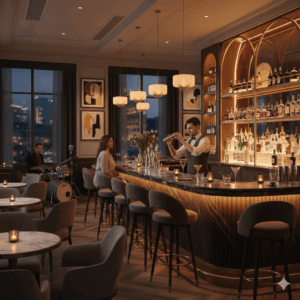
Tokyo’s “happening bars” are usually members-only adult social venues where privacy, house rules, and consent are tightly organized by staff.
If you’re curious, the best approach is simple: pick the right district, prepare the right ID, arrive early for the time slot you want, and follow the venue’s entry flow (often a phone call from a nearby meeting point).
This guide explains what to expect, typical fees and time slots, how to access major areas, and the etiquette and phrases that help you blend in.
In Tokyo nightlife, “happening bars” sit between a regular bar and a members-only lounge: the space is designed for adult conversation and curated encounters, with clear boundaries. Think bar counter + lounge seating, sometimes couple seating, and sometimes additional private zones described on official sites as rooms for closer interaction. For example, COLORS BAR (Kabukicho) introduces itself as an adult entertainment bar where people talk about hobbies and preferences, with multiple seating/room zones described for on-site communication. See their beginner page: Official website (Japanese).
What makes these venues “Tokyo” is the way intimacy is institutionalized: staff-led onboarding, time-slot pricing, identity checks, and rules that prevent unwanted pressure. Many venues emphasize privacy and membership, and ask first-timers to follow an entry route that avoids public addresses. Examples include HARNES TOKYO (Ueno), which provides phone-based entry guidance: Official website (Japanese), and B-DASH (Ikebukuro), which also states phone guidance from a nearby meeting point: Official website (Japanese).
If you only remember one thing: treat happening bars in tokyo like a private club. Bring the requested ID documents, choose a time slot (day vs night), and let staff guide the pace.
Table of Contents
1. What are happening bars in tokyo, and what’s the vibe?
2. Where are the top areas & how do you access them?
3. What do prices, time slots & eligibility look like?
4. Which venue types & services should you expect?
5. How do reservations, etiquette & useful phrases work?
1. What are happening bars in tokyo, and what’s the vibe?

1-1. The “members-only lounge” structure (not a public pub)
Many Tokyo venues describe themselves as “members-only” and put privacy first. B-DASH explicitly frames itself as a membership-based venue and says guests should contact the venue by phone for guidance: Official website (Japanese). HARNES TOKYO also positions itself as a “communication lounge” near Ueno, with a dedicated SYSTEM page that spells out time slots and fees: Official website (Japanese).
1-2. Space design: bar counter, lounge seating, and privacy zones
Official descriptions often focus on the physical layout because the layout is part of the “experience architecture.” COLORS BAR lists multiple zones (bar counter, main floor, couple seating, and a room zone) as part of how people communicate inside: Official website (Japanese). HARNES TOKYO highlights a seated lounge format and a “communication” concept in its own overview: Official website (Japanese).
1-3. The cultural logic: “institutionalized intimacy” with clear boundaries
A key point for visitors: these venues typically rely on staff rules to reduce ambiguity. COLORS BAR tells first-timers that staff explain rules and that forcing unwanted behavior is strictly forbidden: Official website (Japanese). HARNES TOKYO’s membership terms also stress behavior standards and restrictions on devices for privacy: Official website (Japanese).
Tip: If a venue feels “hard to find,” that’s often deliberate. Many member bars use phone guidance and meeting points to keep the entrance discreet and reduce foot traffic confusion.
2. Where are the top areas & how do you access them?

2-1. Shinjuku / Kabukicho: entertainment density and late hours
Kabukicho is Tokyo’s best-known entertainment zone, and it’s also where you’ll see adult venues positioned as part of the broader night economy. For a public, “official” reference point in Kabukicho, GO TOKYO (Tokyo’s official tourism site) lists Tokyu Kabukicho Tower and its access from Shinjuku Station: Official website (Japanese). Kabukicho also has a local official portal run by the area’s shopping street organization: Official website (Japanese).
Example venue access style: COLORS BAR provides step-by-step walking directions from Shinjuku Station East Exit and from Higashi-Shinjuku Station: Official website (Japanese).
2-2. Ueno / Okachimachi: station convenience and “communication lounge” style
Ueno’s advantage is straightforward logistics: multiple rail lines and short walks. HARNES TOKYO’s Q&A states it’s about 2–3 minutes from JR Ueno Station (and even closer from certain subway exits), with phone instructions once you reach the specified exit area: Official website (Japanese). For broader area context, Taito City’s official tourism portal covers Ueno and nearby neighborhoods: Official website (Japanese).
2-3. Ikebukuro: big-station flow and meet-up style entry
Ikebukuro is another major nightlife node with a large station footprint. B-DASH’s SYSTEM page explains that guests should call from a specific spot near Ikebukuro Station’s west side, and notes it’s a short walk from the station: Official website (Japanese). For official local orientation, Toshima City (Ikebukuro’s ward) provides tourism/visitor information resources: Official website (Japanese).
Table 2: Access & Hours
| Station | Walk Time | Hours | Area (JP Link) |
|---|---|---|---|
| Shinjuku Station (East side toward Kabukicho) | 1 min (to Tokyu Kabukicho Tower area) | Varies by facility/venue | Official area page (Japanese) |
| JR Ueno Station (Hirokoji Exit) | 2–3 min (venue guidance by phone) | Day 13:00–19:00 / Night 18:00–05:00 | Official website (Japanese) |
| Ikebukuro Station (West Exit area) | 5 min (west-side meeting point) | Day 13:00–19:00 / Night 18:00–05:00 | Official website (Japanese) |
Notes: “Walk time” above reflects what the linked official pages state. Some venues require you to call from a specified spot; treat that as part of the access plan.
3. What do prices, time slots & eligibility look like?

3-1. Typical fee patterns: day vs night, weekday vs weekend
Many venues divide time into day and night “parts.” For example, HARNES TOKYO lists day hours 13:00–19:00 and night hours 18:00–05:00, with weekday and weekend pricing tiers (including higher weekend night entry): Official website (Japanese).
COLORS BAR shows a three-part schedule (13:00–19:00, 19:00–05:00, and 05:00–13:00) and lists typical entry fees such as male ¥13,000, couple ¥8,000, and women free (plus membership fees): Official website (Japanese).
B-DASH likewise lists weekday vs weekend/holiday-eve price differences (for example, higher weekend night entry), alongside day/night time slots: Official website (Japanese).
3-2. Eligibility and ID: why “two documents” is common
Official pages commonly require membership registration and multiple forms of ID. COLORS BAR states that entry requires an insurance card plus a photo ID (such as a passport) and notes that first-time procedures can take about 15 minutes: Official website (Japanese).
HARNES TOKYO’s Q&A and membership rules also specify bringing two ID items, and they explicitly mention passport-based options for foreign guests: Official website (Japanese) and Official website (Japanese).
Some venues publish additional entry conditions (for example, dress/behavior standards or internal restrictions). Always check the venue’s membership terms before you go so you’re not surprised at the door: Official website (Japanese).
3-3. Planning around trains: get your “last ride” plan early
If you’re moving between districts late at night, check official rail sources for timetables and route planning. Tokyo Metro provides official station/timetable pages in English: Official website (English). For Toei Subway timetables (Tokyo Metropolitan Government’s transport bureau), see: Official website (English).
Table 1: Venue Types & Base Fees
| Venue Type | Typical Fee | Session Time | Area (JP Link) |
|---|---|---|---|
| Kabukicho “underground” members bar (example: COLORS BAR) | Entry: male ¥13,000 / couple ¥8,000 / women free | Parts: 13:00–19:00, 19:00–05:00, 05:00–13:00 | Official website (Japanese) |
| Ueno “communication lounge” style (example: HARNES TOKYO) | Weekday: day ¥9,000 / night ¥13,000 (men) | Day 13:00–19:00 / Night 18:00–05:00 | Official website (Japanese) |
| Large-scale membership venue (example: B-DASH, Ikebukuro) | Weekday: day ¥8,000 / night ¥13,000 (men) | Day 13:00–19:00 / Night 18:00–05:00 | Official website (Japanese) |
Fees and time slots above are taken from the linked official SYSTEM/PRICE pages. Always re-check the official page on the day you go.
Notice: First-time entry can include onboarding steps. For example, one venue states first-time procedures may take about 15 minutes and requires specific ID documents. Plan your arrival time accordingly. (Official website (Japanese))
4. Which venue types & services should you expect?

4-1. Talk-first “communication” venues
Some venues emphasize conversation, seating variety, and an upscale lounge feel. HARNES TOKYO frames itself as a “communication lounge” and details seating capacity and customer age ranges in its Q&A, which helps visitors understand the social scale: Official website (Japanese).
4-2. Kabukicho “entertainment bar” positioning
In Kabukicho, you’ll see venues explicitly position themselves as entertainment bars in the middle of a larger nightlife district. COLORS BAR describes itself as a members-only bar in Kabukicho and talks about a bar counter, couple seating, and a deeper area beyond the main space: Official website (Japanese).
4-3. What “service” means here: structure more than transactions
For visitors, it’s useful to understand “service” as the venue’s structure: time slots, drink systems, staff guidance, and rule enforcement. B-DASH’s SYSTEM page explicitly states it is not a “fuzoku” business and lays out membership rules and device restrictions as part of the environment design: Official website (Japanese).
Tip: If your goal is “easy conversation,” choose a venue that publicly emphasizes lounge seating and staff guidance for first-timers. If your goal is “late-night energy,” pick districts known for high nightlife density (like Kabukicho) and arrive early in the night slot.
5. How do reservations, etiquette & useful phrases work?

5-1. Reservation reality: often “no,” so timing matters
A lot of visitors assume they can book like a restaurant. In practice, some venues explicitly say they do not accept reservations and instead recommend coming early on busy days. HARNES TOKYO’s Q&A states that reservations are not accepted and suggests earlier arrival when congestion is expected: Official website (Japanese).
5-2. Door flow and etiquette: consent, privacy, and device rules
If you want the smoothest entry, follow the venue’s posted flow exactly. Some venues instruct you to call from a specific exit or street point so staff can guide you in (HARNES TOKYO ACCESS): Official website (Japanese). Others do the same from a designated Ikebukuro meeting point (B-DASH SYSTEM): Official website (Japanese).
Etiquette is also spelled out: COLORS BAR says staff explain rules to first-timers and forbids pressuring someone into unwanted behavior, encouraging guests to notify staff if they feel uncomfortable: Official website (Japanese). HARNES TOKYO’s membership terms include strict device-use restrictions inside to protect privacy: Official website (Japanese).
5-3. Useful Japanese phrases: simple, polite, and practical
You don’t need perfect Japanese. Short, polite phrases reduce friction at the door and help staff help you. If you want a structured way to learn “travel-ready” phrases, the Japan Foundation introduces NHK WORLD’s “Easy Japanese” learning resources designed for visitors: Official website (Japanese).
Table 3: Reservation & Eligibility
| Method | Lead Time | Eligibility | Official (JP Link) |
|---|---|---|---|
| Walk-in (no reservations), phone guidance at exit area | Same day; arrive early for busy slots | Age 20+, bring 2 IDs (insurance + photo ID; passport options noted) | Official website (Japanese) |
| Walk-in during business hours; call if you get lost | Same day; allow extra time for first-time onboarding | Adult-only; insurance card + photo ID required (first-time guidance stated) | Official website (Japanese) |
| Membership entry with phone guidance from a meeting point | Same day; check time slots (day/night) | Age 20+, insurance card required + photo ID (per posted rules) | Official website (Japanese) |
Notes: Eligibility and entry methods are venue-specific. The table summarizes what each linked official page states about entry flow and ID expectations.
Table 4: Useful Phrases Quick Ref
| Japanese | Romaji | Plain English | When to use | Official resource |
|---|---|---|---|---|
| すみません | Sumimasen | Excuse me / sorry | Getting attention politely | Official website (Japanese) |
| はじめてです | Hajimete desu | It’s my first time | At the door / onboarding | Official website (Japanese) |
| 英語は大丈夫ですか? | Eigo wa daijoubu desu ka? | Is English OK? | Checking language support | Official website (Japanese) |
| ここで待っています | Koko de matteimasu | I’m waiting here | If entry is by phone guidance | Official website (Japanese) |
Notes: Keep it polite and short. If you can say “first time” and “excuse me,” staff can usually guide you through the venue’s entry flow.
6. Summary and Next Steps
6-1. Your simplest decision framework
Start with “district + time slot.” Kabukicho is dense and energetic; Ueno is logistics-friendly; Ikebukuro is big-station convenient. Then choose day vs night based on your budget and the venue’s posted hours and fees. Use official pages for the final check: COLORS BAR pricing (Japanese) / HARNES TOKYO system (Japanese) / B-DASH system (Japanese).
6-2. Prepare a “door kit” so you don’t waste the night
A practical “door kit” is simple: two acceptable IDs (often including an insurance card + photo ID), a charged phone (for entry calls), and a plan to arrive early if the venue says it doesn’t take reservations. Official ID expectations are typically written clearly on venue pages like: COLORS BAR beginner info (Japanese) and HARNES TOKYO Q&A (Japanese).
6-3. Keep exploring Tokyo nightlife with SoapEmpire
SoapEmpire is a nationwide nightlife portal built for travelers and residents who want clear, organized information—especially when the entry flow is “members-only” and time-sensitive. Visit our official site here: https://soapempire.com/.
Helpful internal reads (no rel needed):
Tokyo red-light district overview /
Shinjuku nightlife guide /
How to book nightlife venues in Japan
If you’re researching happening bars in tokyo, you’ve probably noticed the same challenge again and again: the “real” information is rarely in one place. Entry can be members-only, the access method might require a phone call from a specific meeting point, and the price can change depending on day vs night, weekday vs weekend. Add language pressure and district complexity (Kabukicho vs Ueno vs Ikebukuro), and even confident travelers can lose time—or pick a venue that doesn’t match their goals.
SoapEmpire solves this by organizing the essentials the way a traveler actually uses them: access steps, time slots, pricing ranges, and etiquette notes in plain English, with an emphasis on practical decisions (members-only bars, communication lounges, reservation reality, prices, and etiquette). Instead of guessing, you can choose a district and a time slot that fits your budget, then follow a clean checklist for entry: what ID to bring, what to say at the door, and how to avoid common first-timer friction.
Our advantage is coverage and support. SoapEmpire spans major cities (Tokyo, Osaka, Nagoya, Fukuoka) and focuses on the details that matter to non-Japanese speakers: how access works near the station, what the venue expects at entry, and what “good manners” look like in these highly structured nightlife spaces. And if you don’t want to navigate the booking process alone, we also provide 24-hour booking support for a fixed $10, which is ideal when timing is tight and you want confirmation without stress.
The result is simple: you spend less time searching and more time enjoying Tokyo nightlife with confidence. Whether you’re planning your first visit or trying a new district, SoapEmpire helps you match your intention to the right venue style—then execute the plan smoothly, respectfully, and efficiently.
For reservations or inquiries, please contact us via the inquiry form.
FAQ
Q1. How much should I budget for a first visit?
Many venues publish day/night fees and membership/registration costs. As real examples, official pricing pages show entries like male ¥13,000 at one Kabukicho venue and weekday day entries around ¥8,000–¥9,000 at other venues. Always confirm on the official site before you go:
pricing example (Japanese) /
pricing example (Japanese) /
pricing example (Japanese).
Q2. Do I need a reservation?
Often, no. Some venues explicitly state they do not accept reservations and instead recommend arriving early on busy slots:
official Q&A (Japanese).
Q3. What ID do I need?
Many venues ask for two documents (often an insurance card plus a photo ID such as a passport). Check the venue’s official “beginner” or “member” page for the exact requirement:
official beginner info (Japanese) /
official membership terms (Japanese).
Q4. What are the easiest phrases to remember?
Start with “Sumimasen” (excuse me) and “Hajimete desu” (first time). For structured learning, Japan Foundation’s page on NHK WORLD’s Easy Japanese resources is a solid official starting point:
official resource (Japanese).
If you’re interested in visiting any of these places, SoapEmpire offers a 24-hour booking support service for only $10.
Just send the store name, preferred time, and your name (nickname is fine) to:
artistatakuma@icloud.com.
We’ll take care of your reservation quickly and smoothly.