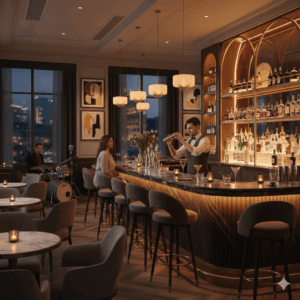
Shinjuku’s night scene is a designed urban space: stations feed into brightly lit streets, buildings channel you through entrances, and staff manage the flow with wristbands, ID checks, and time-based fees. Many venues are built like layered stages—street level for meeting points and food, then basement or upper floors for the main “club” experience.
In “night club” talk, visitors often mean dance clubs (DJ, lights, loud sound) and hybrid entertainment floors (bars, lounges, sometimes live performance). In Japan, the phrase can also overlap with seated hospitality venues—cabaret clubs (kyabakura) and host clubs—where the “service” is institutionalized conversation, time charging, and drink ordering rather than dancing. This article stays focused on mainstream club-going, while noting those adjacent formats as part of Shinjuku’s broader nightlife culture.
Shinjuku’s best-known nightlife neighborhood is Kabukicho, widely introduced as a dense entertainment area close to major lines; for an official overview, see Kabukicho (JNTO official guide).
- 1. Where should you start in shinjuku night clubs?
- 2. How do you reach the main club zones in Shinjuku?
- 3. What do prices, time slots, and age rules look like?
- 4. Which venue types fit your night and comfort level?
- 5. How do reservations, etiquette, and useful phrases work?
- 6. Summary and Next Steps
1. Where should you start in shinjuku night clubs?
1-1 What “night club” means in Shinjuku
In Shinjuku, “night club” usually points to dance clubs with DJs, lasers, and a bar-centered floor plan. Entry is typically a door fee bundled with a drink ticket, and the night is structured by time bands (early vs late). This is not “random”: it’s a practical system that controls crowd density and standardizes what you receive at the door.
A separate category—often also translated as “night clubs”—are seated hospitality venues (cabaret clubs/kyabakura, host clubs). They work more like timed social theaters: you pay for time, order drinks, and the venue provides a consistent “conversation + hosting” format. You don’t need to mix these formats on your first night; choose what matches your goal (dance vs talk).
1-2 The Kabukicho “tower + street” layout
Kabukicho’s modern nightlife is increasingly “vertical.” A key example is Tokyu Kabukicho Tower, a high-rise complex that places large entertainment venues into a single building. Official tourism notes that the basement floors host live venues and a nightclub zone, meaning you can move from street energy to a controlled indoor environment quickly. See Tokyu Kabukicho Tower (GO TOKYO official).
If you want a one-building nightlife plan, this “tower model” is simple: meet near the station, eat nearby, enter the building, and stay inside for the main event. It reduces navigation stress and keeps you close to transport and amenities.
1-3 A simple first-night plan (low friction)
Here is a practical flow that fits how Shinjuku club nights are organized:
- Pick one cluster: Kabukicho (east) or West Shinjuku.
- Arrive early for easier entry pricing and less waiting (many venues price early vs late).
- Have your photo ID ready—ID checks are standard at the entrance.
- Decide in advance: general entry (dance floor) or VIP (seated, time-based).
If Kabukicho is your choice, one of the most navigation-friendly landmarks is ZEROTOKYO inside Tokyu Kabukicho Tower; the venue publishes clear station walking times on its official access page: ZEROTOKYO Access (official).
2. How do you reach the main club zones in Shinjuku?
2-1 Stations that matter (and why)
Shinjuku is a “station city.” Your experience changes depending on which operator and exit you use. If your plan is Kabukicho, the closest station option is often Seibu-Shinjuku; the operator’s official station page is here: Seibu Railway: Seibu-Shinjuku Station (official).
If you are arriving by Odakyu (common for travelers staying along that line), you can review station maps and facilities on the operator’s official page: Odakyu: Shinjuku Station (official).
For West Shinjuku club-going, a major advantage is direct exit guidance: some venues publish “which exit” and “how many minutes,” removing guesswork.
2-2 Walking routes that stay easy (official minutes)
If you want the cleanest “conclusion → number → source” navigation, use official access pages that state walk times:
For West Shinjuku, T2 SHINJUKU publishes a direct route: it lists 3 minutes from JR Shinjuku West Exit and “D5 exit direct connection” from the Toei Oedo Line area—see T2 SHINJUKU Access (official).
2-3 When to move (early entry vs late peak)
Shinjuku club pricing often rewards earlier entry and shifts after 23:00 or midnight. So your “movement strategy” is simple: arrive earlier if you want smoother entry, and move later only if you already know the venue and don’t mind peak density.
A practical, official reference point is WARP SHINJUKU’s published time bands (for example, “OPEN–23:00” and “23:00–04:30” on weekends), which shows how venues segment the night by time: WARP SHINJUKU System (official).
※Reference info (editor’s note): If you are relying on trains, many people plan to be near a station before midnight and treat late night as “stay local” rather than “cross the city.” Always check your exact last-train time for your line and destination.
3. What do prices, time slots, and age rules look like?
3-1 Door fees and drink tickets (real examples)
The most useful way to think about pricing is: you are buying entry plus a standardized first drink (or drink ticket). This keeps the door process fast and reduces negotiation. Here are official, concrete examples:
- WARP SHINJUKU publishes weekend pricing bands: for example, MEN ¥2,000/1D before 23:00 and MEN ¥4,000/1D after 23:00 (Fri/Sat), with women priced separately—see WARP SHINJUKU System (official).
- T2 SHINJUKU’s schedule pages show weekday “regular” pricing, for example MEN ¥1,000/1DRINK (22:00–24:00) and MEN ¥1,500/1DRINK (24:00–LAST), plus LADIES ¥500/1DRINK—see T2 schedule example (official).
- ZEROTOKYO event pages show floor-based pricing. One example lists OPEN 23:00, a ¥1,000 drink ticket for entry to some areas, and MEN ¥2,000/1D / WOMEN ¥1,500/1D for a specific floor—see ZEROTOKYO event example (official).
3-2 VIP tables (what you are actually buying)
VIP is not “better dancing.” It is a different product: a seated base with time structure, staff attention, and bottle/table ordering. In Tokyo club culture, VIP is also a way to create a calmer micro-space inside a loud environment.
T2 SHINJUKU states that VIP seats have a 2 hour timeslot and that a 10% service charge is added (with admission handled separately). This is a clear example of how VIP turns nightlife into a timed, managed service—see T2 VIP (official).
3-3 Age, ID, and payment (cashless differences)
Age and ID checks are the rule, not the exception. The details vary by venue, so treat “system/FAQ” pages as mandatory reading.
- ZEROTOKYO states entry is 20+ and notes it is a cashless venue (except coin lockers). See ZEROTOKYO System (official).
- WARP SHINJUKU states that entry is generally 20+ and that ID checks are required at the entrance. See WARP SHINJUKU System (official).
- T2 SHINJUKU lists an age limit of 18+ (and no high-school students), and explains that ID checks are performed. See T2 System (official).
Table 1: Venue Types & Base Fees
| Venue Type | Typical Fee | Session Time | Area (JP Link) |
|---|---|---|---|
| Large DJ dance club (WARP SHINJUKU) | Weekend example: MEN ¥2,000/1D (OPEN–23:00), MEN ¥4,000/1D (23:00–04:30) | Time-banded entry: OPEN–23:00 and 23:00–04:30 | Official website (Japanese) |
| Multi-floor “tower” club (ZEROTOKYO) | Event example: MEN ¥2,000/1D, WOMEN ¥1,500/1D (floor-based) | Example event: OPEN 23:00 | Official website (Japanese) |
| Station-connected club (T2 SHINJUKU) | Weekday example: MEN ¥1,000/1DRINK (22:00–24:00), MEN ¥1,500/1DRINK (24:00–LAST), LADIES ¥500/1DRINK | Regular bands: 22:00–24:00 and 24:00–LAST | Official website (Japanese) |
| Arena-style nightclub (ATOM SHINJUKU) | Example listing: MENS 1,900円 (22:00–23:00) and MENS 3,900円 (23:00–04:30); LADIES 900円 | Example bands: 22:00–23:00 and 23:00–04:30 | Official website (Japanese) |
Fees are often event- and time-dependent. Use the official “system/schedule” pages for the most accurate nightly pricing.
4. Which venue types fit your night and comfort level?
4-1 Big dance clubs (DJ, lights, crowd flow)
Big clubs in Shinjuku are engineered for throughput: clear entry rules, wristbands, time-banded pricing, and multiple bars. This creates a predictable “night script”: arrive, show ID, pay door + drink, enter, find your zone, and settle into the music cycle.
If you want the classic Kabukicho mega-venue approach, ZEROTOKYO publishes walking times that make it easy to plan: ZEROTOKYO Access (official). For a West Shinjuku plan, T2 SHINJUKU emphasizes direct station connection and published access details: T2 Access (official).
4-2 Hybrid “complex” nightlife (one building, many moods)
Shinjuku’s newer nightlife is often part of a bigger entertainment complex. Tokyu Kabukicho Tower is officially introduced as a multi-purpose facility with hotels, cinema, theater, and basement entertainment floors. That matters because it makes “dinner → show → club” a single-navigation experience rather than a street-by-street puzzle. See Tokyu Kabukicho Tower (GO TOKYO official).
From a cultural viewpoint, this is urban nightlife becoming more “institutional”: the building itself becomes an organizer of social movement, safety norms, and time-based consumption. It’s less improvised than street-only nightlife, and easier for first-time visitors.
4-3 The wider “night club” spectrum (lounges, cabaret clubs, host clubs)
In Japanese nightlife vocabulary, “club” can also point to seated venues where the main “content” is guided conversation, attentive hosting, and drink ordering. These venues are not about a dance floor; they are about structured intimacy—social closeness designed through seating, time charges, and staff roles.
If you are browsing this side of Shinjuku nightlife, Kabukicho’s official portal lists many types of nightlife businesses as part of the neighborhood’s entertainment ecosystem: Kabukicho Official Portal: shop list (Japanese).
Table 2: Access & Hours
| Station | Walk Time | Hours | Area (JP Link) |
|---|---|---|---|
| Seibu-Shinjuku Station → ZEROTOKYO | 1 min | Example event: OPEN 23:00 | Official website (Japanese) |
| JR Shinjuku West Exit → T2 SHINJUKU | 3 min | Listed: OPEN 22:00–LAST | Official website (Japanese) |
| Kabukicho → WARP SHINJUKU | ※Reference info (editor’s note): venue is in Kabukicho; confirm your route on the official page | Fee bands show late-night operation up to 04:30 | Official website (Japanese) |
| Shinjuku area → ATOM SHINJUKU | (See the official access section on the same page) | Example bands: 22:00–04:30 | Official website (Japanese) |
Walk times and hours should be treated as “officially listed values for planning,” and can change by event day. Always confirm on each venue’s official page.
5. How do reservations, etiquette, and useful phrases work?
5-1 Booking options: walk-in, tickets, VIP
Shinjuku clubs often support three entry paths:
- Walk-in: show ID, pay the door fee, receive your drink ticket.
- Ticket: useful on busy nights, and sometimes tied to specific events or floors.
- VIP reservation: a planned seat/time structure for groups or those who want a stable base.
Official pages that clearly support planning include WARP’s system page (fees, rules, and ticket options) here, and T2’s VIP page describing reservation flow (phone/LINE) here.
5-2 Dress, ID flow, and “how to behave” in a crowded club
Shinjuku clubs run on a shared etiquette: ID at the entrance, a quick security flow, and staff-driven crowd management. Many venues publish dress-code guidance as “no extreme casual,” which is really about safety and keeping the venue’s atmosphere consistent.
ZEROTOKYO’s system page is a clean reference for two things first-timers miss: it is a cashless venue (except coin lockers), and it explains that casual commemorative photos are generally fine if they don’t disturb others—see ZEROTOKYO System (official).
5-3 Useful Japanese phrases (quick reference)
These are plain, safe phrases you can use at the door or bar. Keep your tone polite and simple:
- “Eigo daijoubu desu ka?” (Is English okay?)
- “Koko de haratte ii desu ka?” (Can I pay here?)
- “Nyuujou-ryou wa ikura desu ka?” (How much is the entrance fee?)
- “Ichimai (one) onegaishimasu.” (One, please.)
- “Mizu arimasu ka?” (Do you have water?)
- “Sumimasen.” (Excuse me / sorry)
For official, venue-specific rule wording (ID, dress, payment), rely on the “system/FAQ” pages like WARP System or T2 System.
Table 3: Reservation & Eligibility
| Method | Lead Time | Eligibility | Official (JP Link) |
|---|---|---|---|
| Walk-in entry (door fee + drink) | Same day; earlier entry often priced lower (time bands) | Typical large venue: 20+ with photo ID | Official website (Japanese) |
| Event page confirmation (pricing + open time per event) | Same day (check the specific event listing) | Listed: 20+ with ID; cashless noted on system page | Official website (Japanese) |
| VIP seat reservation (time-slot based) | Recommend 1–3 days ahead (editor’s note) | Listed age limit: 18+ (no high-school students), ID required | Official website (Japanese) |
| Check “Today’s Entrance Fee” before going | Same day (posted on the official page) | Listed: 20+ with ID | Official website (Japanese) |
This table prioritizes official system/access pages. Lead time guidance is practical planning advice unless explicitly stated on the official page.
6. Summary and Next Steps
If you came here searching for shinjuku night clubs, the most reliable approach is to treat each venue as a “system”: access route, time-banded pricing, age/ID requirements, and the vibe of the crowd. Shinjuku nightlife is fun precisely because it is structured—once you accept the structure, the night becomes easy to navigate.
Many visitors feel the same friction on their first Shinjuku night: “Which area should I choose—Kabukicho or West Shinjuku?” “How much will it cost after 23:00?” “Will my ID be accepted?” The truth is that Shinjuku nightlife is not hard, but it is highly systemized. Each venue has its own rules for club entry fees, time bands, dress expectations, and age checks, and those details decide whether your night feels smooth or stressful.
SoapEmpire helps you turn that complexity into a simple plan. We translate the “venue system” into clear steps: which station exit to use (Kabukicho vs West Shinjuku), what to expect at the door, how guest lists or tickets work, and how VIP seating changes the rhythm of the night. If you’re deciding between a high-energy dance floor and a calmer, structured hospitality space, we also explain the difference in plain English—so you can match your choice to your comfort level rather than guessing from a listing.
Our strength is practical coverage across Japan’s major cities (Tokyo, Osaka, Nagoya, Fukuoka and more), with a focus on foreigners: fees, access, and how to choose the right place without wasting time. For Shinjuku specifically, we help you compare Kabukicho “tower-style” venues and station-connected clubs, and we keep your plan grounded in what matters: your schedule, your budget, and your preferred atmosphere. If you want a smoother night, we can also support reservations—especially for VIP tables and time-slot seating where planning makes a big difference.
You can start by exploring SoapEmpire’s guides and tools here: SoapEmpire official site. Helpful related articles include Tokyo Nightlife Guide, Shinjuku Kabukicho Guide, How to Book in Japan (Step-by-step), and Osaka Soapland Guide.
For reservations or inquiries, please contact us via the inquiry form.
6-1 Quick checklist for tonight
- Pick one area: Kabukicho (east) or West Shinjuku.
- Confirm the venue’s “system/schedule” page for tonight’s pricing.
- Bring photo ID; expect an ID check.
- Carry a payment method that fits the venue (some are cashless).
- Arrive earlier if you prefer lower pricing bands and less waiting.
6-2 A simple “two-route” plan (Kabukicho vs West Shinjuku)
Kabukicho route: Use Seibu-Shinjuku for the shortest walk to major nightlife buildings, confirm walking minutes on the venue page, then stay within the neighborhood. For example, ZEROTOKYO’s official access page lists a 1-minute walk from Seibu-Shinjuku Station: ZEROTOKYO Access (official).
West Shinjuku route: Pick a venue that publishes a station connection and treat it like a “map.” T2’s access page is a clean model, listing JR Shinjuku West Exit 3 minutes and “D5 exit direct connection”: T2 Access (official).
6-3 FAQ
Q1: How much is entry for Shinjuku night clubs?
Many clubs use “door fee + 1 drink” and change pricing by time. For example, WARP publishes bands like MEN ¥2,000/1D before 23:00 and MEN ¥4,000/1D after 23:00 on Fri/Sat—see WARP System (official).
Q2: Do I need a reservation?
Often no—walk-in is common. Reservations become useful for VIP seats or specific events. T2 explains VIP booking and that VIP seats are a 2-hour timeslot—see T2 VIP (official).
Q3: What age and ID do I need?
Age rules depend on the venue. ZEROTOKYO states 20+ and requires ID—see ZEROTOKYO System (official). T2 lists 18+ (no high-school students) with ID checks—see T2 System (official).
Q4: Which station is best for Kabukicho clubs?
If you want the shortest walk, Seibu-Shinjuku is a common choice. ZEROTOKYO lists Seibu-Shinjuku Station 1 minute on its official access page: ZEROTOKYO Access (official).
If you’re interested in visiting any of these places, SoapEmpire offers a 24-hour booking support service for only $10.
Just send the store name, preferred time, and your name (nickname is fine) to:
artistatakuma@icloud.com.
We’ll take care of your reservation quickly and smoothly.
::contentReference[oaicite:0]{index=0}