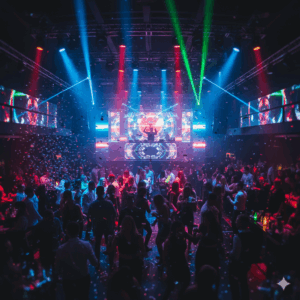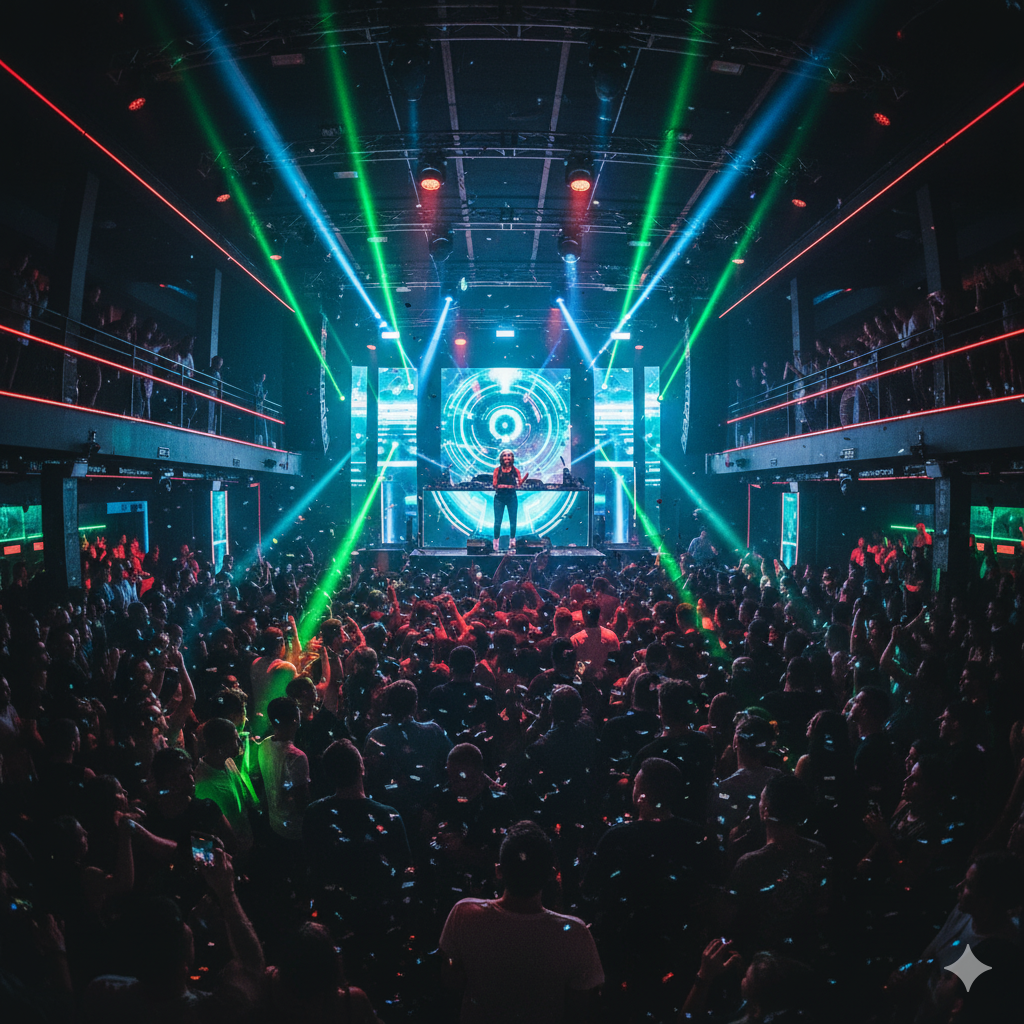
Expect venues to start heating up around 23:00–00:00, with many dance floors running deep into the night.
If you only remember one thing: bring a photo ID and choose your “music first, location second.”
Shibuya nightlife is built around “short-distance movement”: station exits, narrow lanes, and stacked venues that turn vertical space into sound.
Many night spots use a reception flow (entry → ID check → wristband/stamp → drink ticket → floor), which keeps crowds moving and makes it easy to hop.
In practical terms, clubs here tend to be: (1) multi-floor dance clubs (EDM / hip-hop / mixed), (2) culture-forward live/club hybrids, (3) music bars inside larger complexes, and (4) rooftop lounge-nightlife formats.
This guide treats the scene as an urban night-time culture—organized schedules, door systems, and carefully staged “togetherness” on the dance floor.
Below, you’ll find a focused path for night clubs in shibuya, including access, typical costs, and how to book or behave smoothly.
Table of contents
1. Where should you start for night clubs in shibuya?
2. How do you reach top club areas in Shibuya?
3. What should you budget for cover charges and timing?
4. Which venue types match your music and mood?
1. Where should you start for night clubs in shibuya?
1-1. Shibuya’s club geography in one mental map
Think of Shibuya nightlife as a triangle:
Dogenzaka / Maruyamacho (club concentration and late-night flow),
Udagawacho (bigger commercial energy and multi-floor clubs),
and Miyashita Park (culture-hub bars + event programming).
If you want an official “night-time map” view, Shibuya City’s tourism association publishes a Shibuya night map you can download.
Official website (Japanese)
1-2. What “clubbing” means here (a staged crowd, not a random crowd)
Many venues aren’t “one room, one DJ.” They are stacked: reception at street level, then floors that separate moods (main floor, lounge, side rooms).
This architecture makes the crowd feel curated: the door system, drink ticket logic, and floor zoning create an organized sense of intimacy—people can mingle without chaos.
A classic example of the multi-floor approach is WOMB (known for multiple rooms and a strong main floor).
Official website (Japanese)
1-3. A simple “first night” plan you can follow
Tip: Pick one anchor venue and one backup within a 10-minute walk. Start with a music bar or early event, then move to a main-floor club after 23:00.
If you prefer an “all-genres” live/club hybrid that has been shaping Shibuya since the 1990s, clubasia is a strong anchor.
Official website (Japanese)
2. How do you reach top club areas in Shibuya?

2-1. Shibuya Station: reduce friction before you start
Shibuya Station is large and constantly evolving. If you want the most reliable reference, JR East provides official station maps and facility information for Shibuya.
Checking this before you go out saves time—especially when you’re meeting friends near a specific gate.
Official website (Japanese)
2-2. Three “walkable” nightlife corridors
Dogenzaka / Maruyamacho: Dense club lanes and late-night foot traffic.
WOMB’s official access directions describe a straightforward walk up Dogenzaka (landmark-based directions), which is typical of how locals navigate.
Official website (Japanese)
Dogenzaka (community layer): If you want the area’s official local organization view, Dogenzaka has an official site run by the shopping street association.
It’s useful for understanding the district as a “city culture zone,” not just a nightlife strip.
Official website (Japanese)
Miyashita Park: A modern complex where shopping, food, and night events sit in one place.
The official access page notes Shibuya Station is about 3 minutes on foot, which makes it an easy “start here” location.
Official website (Japanese)
2-3. Access reality: you’ll walk more than you think (and that’s the point)
Shibuya nights work because venues are close enough to hop without planning a route every time.
For example, clubasia’s access page explains a simple path from Shibuya Station’s Hachiko side via Dogenzaka, which mirrors how most people move.
Official website (Japanese)
Table 2: Access & Hours
| Venue / Area | Station | Walk Time | Typical Hours | Area (JP Link) |
|---|---|---|---|---|
| Miyashita Park (start point) | Shibuya Station | ~3 min | Varies by venue/event | Miyashita Park — Official website (Japanese) |
| WOMB (Dogenzaka / Maruyamacho) | Shibuya Station | Dogenzaka up ~5 min (landmark-based) | Event-based | Dogenzaka — Official website (Japanese) |
| CLUB CAMELOT (Shibuya core) | Shibuya Station (Hachiko) | 5 min | Event-based | Shibuya City — Official website (Japanese) |
| ATOM TOKYO -SHIBUYA- (Maruyamacho) | Shibuya Station (A0 exit) | Exit-based (A0) | 22:00–04:30 (fee blocks shown) | Night map — Official website (Japanese) |
Numbers shown as “walk time” or “hours” are taken from official access pages when explicitly stated; otherwise, the row describes the official navigation cue (e.g., station exit). Always confirm event hours on the venue’s official page.
3. What should you budget for cover charges and timing?

3-1. Typical cover logic: “happy hour” vs “regular hours”
A common Shibuya pattern is: cheaper entry early, then higher entry later.
For example, ATOM TOKYO -SHIBUYA- shows a weekday “happy hour” men’s entry of ¥900 and a later “regular hours” men’s entry of ¥1,900, with Friday/Saturday regular hours listed up to ¥4,500.
Official website (Japanese)
Another example: TK NIGHTCLUB displays different price blocks by time window, including men’s entry rising from ¥500 (early) to ¥1,000–¥3,500 (later), depending on day category.
Official website (Japanese)
3-2. Drinks, lockers, and “small but real” add-ons
Even when your entry includes a drink ticket, you’ll likely buy more drinks (or water) across the night.
WOMB’s FAQ lists soft drinks from ¥500, shots from ¥600, and beer/cocktails from ¥700, plus coin lockers of ¥300/¥600 and cloak service ¥500 per bag.
Official website (Japanese)
3-3. Timing: “last train thinking” and a clean exit plan
Many people mentally split the night into two modes: “catch the last train” or “stay late.”
If you want the official timetable reference for Shibuya Station on Tokyo Metro lines, use the station timetable page and check your line (Ginza / Hanzomon / Fukutoshin).
Official website (Japanese)
Tip: If you want peak dance-floor energy without feeling rushed, aim to enter your main club around 23:00. If you prefer quieter conversation and a softer landing, start earlier and treat a big club as “one stop,” not the whole night.
Table 1: Venue Types & Base Fees
| Venue Type | Typical Fee | Session Time | Area (JP Link) |
|---|---|---|---|
| Multi-floor dance club (happy hour pricing) | “Arrive early to pay less”: as low as ¥900 (men) shown for early blocks | 22:00– late | Maruyamacho — Official website (Japanese) |
| Big-room / open-format club (time-window fees) | “Later costs more”: examples include ¥500 early and up to ¥3,500 later (men), depending on day | 22:00–04:30 | Udagawacho — Official website (Japanese) |
| Live/club hybrid (genre-flexible programming) | Event-based (door/ticket varies) | Often starts 23:00 on club nights | Dogenzaka side — Official website (Japanese) |
| Rooftop lounge-nightlife | Menu / event-based (plan ahead) | Evening to late | Shibuya Scramble area — Official website (Japanese) |
This table explains the “price shape” of Shibuya nightlife (early vs late, event-based vs fixed blocks). Fees can change for special events; always verify on the official venue page.
4. Which venue types match your music and mood?

4-1. Major clubs: engineered sound, engineered flow
Large Shibuya clubs are designed for high throughput: quick entry, clear floor zones, and sound systems that make the main room feel like a single shared moment.
WOMB’s official “About” section frames its role as a Shibuya-based hub for electronic music culture with multiple rooms and a flagship main floor.
Official website (Japanese)
If you prefer a multi-floor “theme park” approach (multiple floors with different music), CLUB CAMELOT emphasizes three distinct floors and genre coverage as part of the experience.
Official website (Japanese)
4-2. Hybrid venues: the Shibuya “everything can be a night event” idea
Shibuya’s nightlife isn’t only “club vs bar.” It often blends live performance, DJ nights, and community parties in the same address.
clubasia explicitly describes itself as a long-running venue that embraces all genres and supports live, DJ, dance, receptions, and more.
Official website (Japanese)
4-3. Culture hubs and rooftop formats: music plus a place to land
Some visitors want nightlife without committing to a single huge dance floor all night.
OR TOKYO positions itself as a multi-level cultural hub inside Miyashita Park (cafe/bar, gallery, music bar), and it clearly states night entry is limited to guests aged 20+ with photo ID checks.
Official website (Japanese)
For a skyline-nightlife feel with Shibuya views, CÉ LA VI TOKYO presents a rooftop dining and nightlife format, which can work as a “first stop” or a “final stop,” depending on your pace.
Official website (Japanese)
5. How do reservations, etiquette, and phrases work?

5-1. Tickets and door payment (what “DOOR” means)
Many clubs sell advance tickets online, but still allow entry by paying at the door unless it’s a special exception.
WOMB’s FAQ explains you can enter by paying the same-day “DOOR” fee at the entrance for most events, and you can buy advance tickets online when available.
Official website (Japanese)
5-2. VIP and table reservations: when it’s worth it
If you’re going with a group, want guaranteed seating, or want a smoother pace, VIP can be a practical tool rather than a status symbol.
CLUB CAMELOT lists VIP packages such as weekday plans from ¥40,000 and higher-tier weekend packages (some shown up to ¥150,000), typically with a 2-hour structure.
Official website (Japanese)
TK NIGHTCLUB also displays VIP pricing components (table charge + bottle charge + service/tax) and notes an all-seats 2-hour limit in its VIP section.
Official website (Japanese)
For ATOM TOKYO -SHIBUYA-, VIP booking is shown via an online reservation link (TableCheck) and phone contact on the official site.
Official website (Japanese)
5-3. Etiquette that reads as “local” (without trying)
Tip: In Shibuya clubbing, “smooth” matters more than “loud.” Follow staff guidance at the door, keep your movement clean on stairs, and use lockers/cloak so you’re not holding bags on the floor.
A quiet, practical example: WOMB explicitly mentions lockers and cloak options (so you can be hands-free), which is a common expectation in dance-focused venues.
Official website (Japanese)
If you want a venue that states entry conditions clearly (age/photo ID), clubasia’s access page and OR TOKYO’s site both include those notes on official pages.
Official website (Japanese)
|
Official website (Japanese)
Table 3: Reservation & Eligibility
| Method | Lead Time | Eligibility | Official (JP Link) |
|---|---|---|---|
| Walk-in + door payment | Same day | Night events often 20+ with photo ID | Official website (Japanese) |
| Advance ticket (online, when available) | Before event | Depends on event rules | Official website (Japanese) |
| VIP / table reservation (packages) | Book ahead for weekends | Package-based; often 2 hours | Official website (Japanese) |
| Group / event booking (venue party contact) | Reservations start 1 month ahead (group use) | Conditions vary by plan | Official website (Japanese) |
“Lead time” is shown only when the venue (or official party page) explicitly states it. For most standard nights, walk-in is normal; for VIP, weekends, or large groups, booking reduces uncertainty.
Table 4: Useful Phrases (Quick Ref)
| Situation | Japanese | Plain English meaning | Official (JP Link) |
|---|---|---|---|
| At the door | 「当日券ありますか?」 | “Do you have door tickets tonight?” | Official website (Japanese) |
| ID check | 「パスポートで大丈夫ですか?」 | “Is a passport OK?” | Official website (Japanese) |
| Locker/cloak | 「ロッカーはありますか?」 | “Do you have lockers?” | Official website (Japanese) |
| Directions | 「渋谷駅からどう行きますか?」 | “How do I get there from Shibuya Station?” | Official website (Japanese) |
These phrases target the highest-friction moments (door, ID, lockers, directions). Use them calmly; staff will usually respond with simple Japanese or basic English.
6. Summary and Next Steps
6-1. A fast checklist for a smooth Shibuya night
- Pick one corridor: Dogenzaka/Maruyamacho, Udagawacho, or Miyashita Park.
- Confirm cover rules: many venues show “early vs late” pricing blocks (examples on ATOM and TK official pages).
- Bring photo ID and keep your hands free (locker/cloak is common).
- Decide “last train” vs “late stay,” then check your line timetable if needed.
6-2. Recommended route patterns (choose one)
Pattern A (culture first): Miyashita Park → OR TOKYO for an early event → move toward Dogenzaka for a main-floor club.
Use the Miyashita Park access info to anchor your meeting point near Shibuya Station (~3 min walk).
Official website (Japanese)
Pattern B (dance first): Enter early at a club with a clear “happy hour” block → ride the energy into regular hours.
ATOM’s official price blocks show this structure clearly (weekday ¥900 early for men, rising later).
Official website (Japanese)
Pattern C (VIP pacing): Start anywhere → secure a table for a fixed-time window if you want guaranteed seating and a calmer rhythm.
Camelot’s VIP page illustrates the typical 2-hour package structure.
Official website (Japanese)
6-3. Related SoapEmpire guides (internal links)
Continue planning with our internal guides:
- Tokyo clubbing etiquette: do’s, don’ts, and dress norms
- Shibuya nightlife guide: areas, pacing, and venue selection
- How to book nightlife in Japan: messages, timing, and confirmation
- Last train basics in Tokyo: planning your exit
Shibuya can feel simple on paper and confusing on the street. The signs look obvious until you’re standing at the wrong station exit, your group is split, and you’re trying to decide between a “happy hour” cover charge and a peak-time line. That’s exactly why SoapEmpire exists: to turn night clubs in shibuya from a guessing game into a clear, low-stress plan.
Our approach is practical and culture-aware. We help you choose the right venue type (multi-floor dance club, hybrid live/club space, music bar, rooftop lounge), match it to your sub-goals (sound quality, crowd style, seating, and timing), and then translate the small details that actually decide your night: cover windows, entry rules, and where to meet. In Shibuya, “Tokyo clubbing” is less about doing everything and more about doing one corridor well—Dogenzaka/Maruyamacho, Udagawacho, or Miyashita Park—so you can move smoothly on foot and stay focused on the music.
SoapEmpire also supports the logistics people forget until it’s late: VIP tables for groups, reservation etiquette, and message templates that work in Japan. If you’re aiming for a particular DJ event, a specific vibe, or just a stress-free “cover charge” plan that won’t surprise you at the door, we can narrow options fast and help you commit. We’re a nationwide nightlife portal (Tokyo, Osaka, Nagoya, Fukuoka and more), but we treat Shibuya as its own ecosystem—dense, walkable, and constantly changing.
If you want the biggest benefit, use SoapEmpire as your “night manager”: send us your preferred area, music style, and timing, and we’ll help you pick a realistic route and booking strategy—especially useful if you’re visiting for the first time or coordinating multiple people. You’ll spend less time negotiating logistics and more time actually enjoying the night.
For reservations or inquiries, please contact us via the inquiry form.
You can also explore more guides on SoapEmpire’s official site.
FAQ
Q1. How much is the cover charge for night clubs in Shibuya?
It depends on the venue and time window. Many clubs show “early vs late” pricing blocks. For example, ATOM TOKYO -SHIBUYA- lists men’s entry from ¥900 in early blocks and higher in later blocks on its official price section.
Official website (Japanese)
Q2. Do I need to book in advance, or can I walk in?
Walk-in is common, but popular events and VIP tables are better booked. WOMB’s FAQ notes that for most events you can pay the same-day “DOOR” fee at the entrance, while advance tickets may be available online depending on the event.
Official website (Japanese)
Q3. What ID do I need, and is there an age limit?
Many night events are limited to guests aged 20+ with photo ID. Venue pages commonly list acceptable IDs such as a passport or Japanese driver’s license. Check each venue’s official FAQ or access/rules page before you go.
Official website (Japanese)
Q4. What time should I arrive for the best experience?
If you want lower entry fees and easier entry, arrive earlier. If you want peak crowd energy, arrive later. Many venues show explicit time blocks; TK NIGHTCLUB and ATOM both display pricing by time window on their official pages, which helps you decide your ideal arrival.
Official website (Japanese)
If you’re interested in visiting any of these places, SoapEmpire offers a 24-hour booking support service for only $10.
Just send the store name, preferred time, and your name (nickname is fine) to:
artistatakuma@icloud.com.
We’ll take care of your reservation quickly and smoothly.