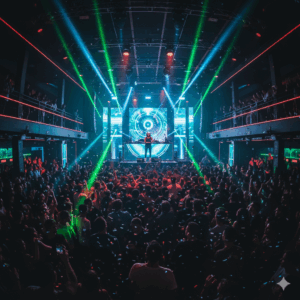
Expect cover fees that change by time and event, plus a predictable flow (queue → ID check → pay → locker → floor).
If you want a simple starting point, choose Shibuya for density, Roppongi for clear systems, and Kabukicho for all-in-one buildings.
Tokyo dance clubs are not random “party rooms.” They are designed urban night spaces with a clear layout and a managed flow: an entrance desk that controls entry, a main floor built around sound and lighting, side zones for recovery (bar edges, lounge corners), and—often—VIP seating that turns a chaotic night into a readable set of steps.
The “service” is straightforward and institutional: you pay a cover (sometimes bundled with drink tickets), store items in lockers or a cloak service, then enter a curated environment where DJs, staff, and spatial design guide how people move and socialize. In practice, it is a system of managed proximity—crowd energy on the main floor, quieter talk at the edges, and a predictable rhythm of entry and exit.
Typical users include adults in their 20s–50s (travelers and residents). Many nights split into two patterns: early arrival for smoother entry and space, or late arrival for peak atmosphere. If you want the city-culture angle, Shibuya is explicitly described as a place where club music is part of the broader cultural scene on Tokyo’s official tourism site:
Official website (Japanese).
1. Where should you start in dance clubs tokyo?
2. Which Tokyo areas are best for club-hopping, and how do you access them?
3. What do prices, hours, and age rules usually look like?
4. Which venue types and music styles should you choose?
5. How do reservations, etiquette, and useful phrases work?
1. Where should you start in dance clubs tokyo?
1-1. Use a “rules-first” mindset (system beats hype)
The fastest way to enjoy Tokyo nightclubs is to prioritize clarity over reputation. Your goal is simple: know what happens at the door, what you will pay, and what you need to show. For a concrete example, V2 TOKYO publicly posts a system that includes weekday and weekend entrance fees and drink-ticket bundles—so you can plan with real numbers before you leave your hotel:
Official website (Japanese).
1-2. Pick one anchor venue, then add one backup within walking distance
A smooth first night is not “many stops.” It is one anchor venue (where you stay the longest) plus one backup option nearby. Shibuya is strong for this approach because venues and late-night streets cluster tightly—and Tokyo’s official Shibuya guide explicitly frames the area’s cultural mix (including club music) as part of the neighborhood identity:
Official website (English).
1-3. Understand the “Tokyo club flow” (what the night feels like in steps)
Most dance clubs in Tokyo run on a predictable choreography: queue → ID check → cover payment → wristband/stamp → lockers/cloak → bar → main floor. This is not just convenience—it is how crowded nights remain readable. If you want a venue example that describes its spatial concept as a multi-floor environment built around experience design, WOMB’s official “About” page is a useful reference:
Official website (Japanese).
2. Which Tokyo areas are best for club-hopping, and how do you access them?
2-1. Shibuya: dense clusters and walkable options
Shibuya is ideal when you want to keep movement simple: many venues are reachable within one neighborhood loop. Tokyo’s official Shibuya area guide also lists the rail lines serving Shibuya Station, which helps you plan returns and meet-ups:
Official website (Japanese).
For a venue-level reference point in Shibuya nightlife, WOMB publishes an official access page with map guidance:
Official website (Japanese).
2-2. Roppongi: station-friendly entry and clear “system” culture
Roppongi works well if you want a straightforward arrival. Tokyo’s official Roppongi guide frames the district as a late-night hub of restaurants, bars, and clubs:
Official website (Japanese).
For a concrete access example with walk time, V2 TOKYO posts that Roppongi Station exits are about 1 minute on foot:
Official website (Japanese).
2-3. Kabukicho (Shinjuku): big late-night buildings and landmark navigation
Kabukicho is useful when you prefer landmark navigation over small streets. Tokyo’s official Shinjuku guide helps you place the area within the city’s geography:
Official website (Japanese).
For precise station walking times to a major venue, ZEROTOKYO’s access page lists nearby stations and walk times such as Seibu-Shinjuku Station (1 min) and Shinjuku Station (7 min):
Official website (Japanese).
Table 2: Access & Hours
| Station / Landmark | Walk Time | Hours (Published Example) | Area (JP Link) |
|---|---|---|---|
| Roppongi Station (Oedo/Hibiya) | 1 min (V2 example) | Event-based; check system page | Official website (Japanese) |
| Seibu-Shinjuku Station | 1 min (ZEROTOKYO) | Event-based; check venue pages | Official website (Japanese) |
| Shinjuku Station | 7 min (ZEROTOKYO) | Event-based; check venue pages | Official website (Japanese) |
| Shibuya (Dogenzaka / Maruyama-cho side) | Use official access pages | Event-based; confirm on day | Official website (Japanese) |
Walk times are the safest numbers to trust when they are published on the venue’s official access page. Hours vary by event and day—re-check official pages before you go.
3. What do prices, hours, and age rules usually look like?
3-1. Cover fees: think “time tiers,” not one fixed price
The most common Tokyo pattern is: earlier entry is cheaper, later entry is higher, and special events override normal prices. For example, V2 TOKYO publicly lists men’s entry as ¥2,000 (weekday, 1 drink ticket) and ¥4,000 (weekend, 2 drink tickets):
Official website (Japanese).
In Shibuya, TK NIGHTCLUB posts “Today’s Entrance Fee” tiers (time blocks) such as 22:00–23:45 vs 23:45–4:30 with different prices:
Official website (Japanese).
3-2. Hours: many clubs are “late-start, late-finish” by design
Tokyo club nights often begin late, which is why planning your arrival matters. TK NIGHTCLUB clearly posts an opening hour of 22:00–4:30 as a standard window:
Official website (Japanese).
Some venues publish detailed weekly hour blocks; for example, 1 OAK TOKYO posts day-by-day opening times (including late-night closing):
Official website.
Hybrid spaces may start earlier and shift late; OR TOKYO posts daytime opening and late-night closing windows (Mon–Sat listed to 5 AM):
Official website.
3-3. Age & ID: assume you will need photo ID at night
The simplest assumption for dance clubs tokyo is: bring photo ID and expect age-based entry rules at night. CIRCUS TOKYO explicitly states that photo ID is required for entry and that late-night events after 22:00 do not allow under-20 entry:
Official website (Japanese).
OR TOKYO also posts an age rule for late-night operation as part of its venue policy:
Official website.
Table 1: Venue Types & Base Fees
| Venue Type | Typical Fee (Published Example) | Session Time | Area (JP Link) |
|---|---|---|---|
| System-page “big club” (Roppongi clubs) | ¥2,000 weekday (1D) / ¥4,000 weekend (2D) (V2 example) | All-night format (event-based) | Official website (Japanese) |
| Time-tier entrance club (Shibuya clubs) | 22:00–23:45 vs 23:45–4:30 pricing (TK example) | 22:00–4:30 (posted) | Official website (Japanese) |
| Multi-floor culture hub (café/gallery/music bar) | Event-based; confirm on official page | Mon–Sat listed to 5 AM (posted) | Official website |
| Music-first room (techno/house with strong sound identity) | Event-based; confirm per night | Event-based (start times vary) | Official website (Japanese) |
Prices and times change with events and seasons. The safest habit is to treat official “system/FAQ” pages as the source of truth on the day you go.
4. Which venue types and music styles should you choose?
4-1. Music-first clubs: sound, lighting, and curated nights
If your priority is techno/house (or any genre where the room matters), look for venues that emphasize sound system and floor identity. WOMB’s official description frames the venue as a multi-level club experience built around its concept and space:
Official website (Japanese).
This is the “music-first” mindset: the room is designed to hold energy for hours, not just play background music.
4-2. Multi-floor venues: one building, multiple moods
Multi-floor spaces are especially useful for mixed groups. Instead of arguing about one vibe, you shift within the building: main-floor intensity, side-floor social time, and lounge recovery. OR TOKYO explicitly describes itself as a layered space (café/gallery/music bar), which makes it a good example of “day-to-night” nightlife architecture:
Official website.
ZEROTOKYO also presents itself as a large-scale venue with multiple floors and zones (official “About” page):
Official website (Japanese).
4-3. The practical services that affect your comfort (lockers, cloak, drinks)
Comfort is not just music—it is logistics. Conclusion: you will last longer if you store items and keep your hands free. WOMB’s FAQ publicly lists locker prices such as ¥300/¥600 and a cloak fee such as ¥500, plus example drink price bands (soft drinks from ¥500 and more):
Official website (Japanese).
Treat these details as part of the “real cost” of staying out late.
5. How do reservations, etiquette, and useful phrases work?
5-1. Tickets: when “advance” removes stress
Conclusion: if a night is popular, advance tickets reduce uncertainty at the door. Some venues clearly explain how ticketing works. WOMB’s FAQ notes that door fees depend on the event page and that advance tickets may be available online:
Official website (Japanese).
When the official page says the fee is event-based, trust that—it means the price is part of that night’s design.
5-2. VIP tables: use official pages and time windows
Conclusion: VIP reservations are usually the most formal part of Tokyo nightlife—so treat them like a booking system, not a casual request. ZEROTOKYO publishes VIP reservation channels (including an online request and phone/LINE reception windows such as 20:00–26:00 on stated days):
Official website (Japanese).
V2 TOKYO also publishes VIP table pricing structures (set time basis) and the idea that table seating follows a structured fee format:
Official website (Japanese).
5-3. Useful Japanese phrases (simple, polite, effective)
You do not need perfect Japanese. Use short phrases that match the club flow:
- 入れますか? (Hairemasu ka?) — “Can we enter?”
- 何時までですか? (Nan-ji made desu ka?) — “Until what time?”
- チケットあります。 (Chiketto arimasu.) — “I have a ticket.”
- 身分証あります。 (Mibunshō arimasu.) — “I have my ID.”
- ロッカーはどこですか? (Rokkā wa doko desu ka?) — “Where are the lockers?”
- 再入場できますか? (Sai-nyūjō dekimasu ka?) — “Can I re-enter?”
- VIPを予約したいです。 (VIP o yoyaku shitai desu.) — “I want to reserve VIP.”
If you want a concrete reminder that photo ID can be required at night, CIRCUS TOKYO states it plainly:
Official website (Japanese).
Table 3: Reservation & Eligibility
| Method | Lead Time | Eligibility | Official (JP Link) |
|---|---|---|---|
| VIP request (online / phone / LINE windows) | Use published reception window like 20:00–26:00 (when stated) | Follow venue policy; bring photo ID | Official website (Japanese) |
| System-page VIP tables (set-time structure) | Reserve earlier for weekend nights (best practice) | ID check at entry (posted policy) | Official website (Japanese) |
| Venue rules / FAQ first (tickets, lockers, fees) | Confirm on the same day for event nights | Event-based entry; bring ID | Official website (Japanese) |
If you only do one thing: read the official “system/FAQ/access” pages before you leave. That single habit prevents most first-timer confusion.
6. Summary and Next Steps
If you’re new to dance clubs tokyo, the biggest challenge is not “where is the best party?” It is uncertainty: unclear prices, confusing exits, not knowing whether you need tickets, and not knowing what staff will ask at the door. The solution is a simple planning rhythm: choose one base area (Shibuya clubs for density, Roppongi clubs for clear systems, or Kabukicho nightlife for big late-night buildings), check one official “system/FAQ/access” page, and decide your timing (arrive early for smoother entry, or later for peak energy).
SoapEmpire exists to turn nightlife guesswork into a predictable flow. We write plain-English guides that focus on logistics (fees, entry rules, station routes, and reservation methods) so your night stays calm and confident. Instead of scrolling through mixed-quality tips, you get a short checklist: what to bring, what to say, where to meet, and which official pages to verify on the day. That matters in Tokyo because clubs are designed spaces with managed entry—once you understand the “system,” the night becomes easy.
Our strength is practical English support across Tokyo and other major cities, plus a clear way to act when you find a venue you like. If your plan includes VIP seating, a guest list, or a specific event, we can help you format the request and communicate it smoothly. You tell us the venue name, the date, your target time, and your group size. We help you align that request with the venue’s posted rules, then move the process forward without unnecessary back-and-forth. The benefit is simple: less confusion at the door, fewer timing mistakes, and a night that starts on time.
To keep things realistic: prices and entry rules can change by night. That’s why our approach always begins with official sources (system pages, access pages, and venue FAQs) and then turns them into a usable plan. This is also why we recommend choosing one “anchor venue” first—once you have one reliable base, you can improvise the rest of the night. If you want extra context, we also cover adjacent nightlife formats and etiquette patterns in plain English, so you understand the broader urban culture around Tokyo nights without getting lost in jargon.
For reservations or inquiries, please contact us via the inquiry form.
6-1. A quick “first night” plan you can copy
- Choose one base: Shibuya (walkable), Roppongi (system clarity), or Kabukicho (landmarks).
- Check one official page for your anchor venue (fees + ID + access).
- Arrive earlier if you want lower stress; arrive later if you want peak energy.
- Use lockers/cloak early, keep your hands free, and enjoy the floor.
6-2. Related SoapEmpire guides (internal resources)
- Dance clubs tokyo: how to plan a smooth night out in Tokyo
- A practical guide to Shibuya clubs for first-timers
- How to enjoy Japan Roppongi nightlife from dinner to dawn
Official SoapEmpire site reference:
SoapEmpire official website.
6-3. FAQ
Q1. How much should I budget for a first club night in Tokyo?
A practical starting budget is cover + a few drinks. As a clear example, one Roppongi system page lists men’s entry at ¥2,000 weekday or ¥4,000 weekend (with drink tickets included), which shows the kind of baseline you can expect:
Official website (Japanese).
Q2. Do I need tickets, or can I pay at the door?
Both exist. Many nights allow door payment, but some nights sell advance tickets online. A simple way to decide is: if the official page frames the night as “event-based,” treat tickets as the lower-stress option. WOMB’s FAQ explains that door fees depend on the event listing and that advance tickets may be available:
Official website (Japanese).
Q3. Is English enough at the entrance?
Often yes for basic entry steps, but you should rely on the official posted rules so you don’t need long conversations. If you want a “no ambiguity” approach, pick a venue with clearly posted system fees and access (for example, V2’s system page or TK’s posted entrance tiers):
Official website (Japanese) |
Official website (Japanese).
Q4. What time should I arrive?
Arrive earlier if you want smoother entry and more space; arrive later if you want peak energy. Many venues publish standard late-night windows such as 22:00–4:30 (TK example), which helps you time your move:
Official website (Japanese).
If you’re interested in visiting any of these places, SoapEmpire offers a 24-hour booking support service for only $10.
Just send the store name, preferred time, and your name (nickname is fine) to:
artistatakuma@icloud.com.
We’ll take care of your reservation quickly and smoothly.