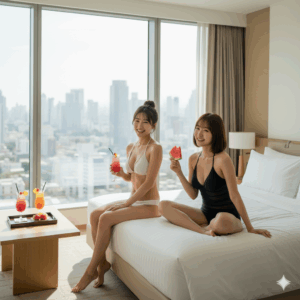
In Ikebukuro, couples hotels commonly sell “Rest” (short stay) and “Stay” (overnight) in clear time blocks, so you can plan your night without guessing.
A weekday short stay can start around ¥3,000 / 2 hours at Hotel Mint Ikebukuro (Official website (Japanese)), while Hotel Time’s lists ¥4,900 / 2 hours for an entry room type on weekdays (Official website (Japanese)).
If you want a more “resort-style” experience with web booking options, Hotel Petit Bali Ikebukuro lists day-use from ¥3,900 and stay from ¥7,900 (Official website (Japanese)).
This guide explains the modern “couples hotel” (often called a love hotel) as a piece of Tokyo’s nighttime urban design. In Ikebukuro, the typical layout is optimized for privacy and speed: a compact entrance, a room-selection panel or front desk, and a direct route to an elevator and private room. Many buildings are “station-near” and vertical, reflecting high land value and the need to move people efficiently through dense nightlife streets.
The service is not “mysterious” once you see the system: you rent a private room either for a short block (Rest / day use) or for an overnight block (Stay). The experience is structured around time windows (check-in rules), room grades (A/B/C types), and add-ons such as food, drinks, baths, or in-room entertainment. These rules are posted openly on official sites—for example, Hotel Time’s shows fixed time windows for 2-hour and 3-hour stays and an extension fee per 30 minutes (Official website (Japanese)).
Anthropologically, these hotels are a “social technology” for urban intimacy: they let people create a temporary private zone (quiet, controlled lighting, themed interiors, and predictable billing) inside a very public city. That predictability is why travelers also use them for day use, breaks between plans, or a comfortable overnight near a major hub like Ikebukuro Station (JR East station info (Japanese)).
1. Where should you start in ikebukuro love hotel?
2. How do you access top areas?
3. What should you expect for prices, time & eligibility?
4. Which venue types & services fit your plan?
1. Where should you start in ikebukuro love hotel?

1-1 What makes Ikebukuro a practical base for night plans?
Ikebukuro works well for nightlife logistics because it is a major multi-line hub, so “meeting → moving → checking in” is usually fast. If you’re planning around trains, start by checking station exit and facility information on the official railway pages (JR East: Ikebukuro Station info (Japanese); Tokyo Metro: Ikebukuro Station info (Japanese)).
For a “city culture” framing: Ikebukuro’s mix of theaters, parks, and large commercial complexes produces a flow of people that keeps streets lively across many hours. For example, Toshima City describes Ikebukuro West Gate Park (GLOBAL RING) as a cultural and information hub and lists the park’s opening hours (Official website (Japanese)).
1-2 Pick your style: budget quick-stop vs comfort “resort” rooms
Ikebukuro’s couples hotels are not one single “tier.” Some are optimized for a quick, low-friction short stay (day use), while others focus on themed interiors and expanded amenities (larger TVs, baths, in-room entertainment, food menus). When you compare hotels, the fastest way is to scan the official “system” (time windows + prices) and “service” (amenities) pages.
Example: Hotel Time’s publishes clear time blocks (2-hour / 3-hour, plus stay windows) and per-room-type pricing on its official system page (Official website (Japanese)). Hotel Mint Ikebukuro also posts a room-type price table including short time, rest, stay, and extension fees (Official website (Japanese)).
1-3 A simple decision checklist (couples hotel basics)
Use this checklist:
- Time: Do you want 2–3 hours (short stay / day use) or an overnight block?
- Location: West side vs North side vs Metro exits—your walking time matters at night.
- Reservation: Walk-in is common, but some hotels accept phone or web booking (see official “reservation” notes).
- Amenities: Food menu, bath types, in-room entertainment, and payment methods.
2. How do you access top areas?

2-1 Use official station pages to avoid exit confusion
Ikebukuro Station is large and multi-operator, so “which exit” is the real first step. Start from official station guidance:
JR East station maps and barrier-free routes (JR East (Japanese)) and Tokyo Metro’s Ikebukuro station page with exit guidance and surrounding landmarks (Tokyo Metro (Japanese)).
If you come via private railways, Tobu and Seibu also publish official station information pages (Tobu Railway (Japanese), Seibu Railway (Japanese)).
2-2 West side vs North side: how the clusters feel
The West side (Nishi-Ikebukuro) is convenient if you’re moving between theaters, parks, and station-side hotels. Toshima City’s official page for Ikebukuro West Gate Park is useful as a landmark reference point and includes the facility address and opening hours (Official website (Japanese)).
The North side cluster is popular for “quick access, quick check-in” choices. For example, Hotel Mint Ikebukuro states it is about a 5-minute walk from the North Exit on its official access page (Official website (Japanese)).
2-3 If you’re pairing plans: large complexes as easy meet-up points
If your plan includes shopping, food, or an indoor landmark before a hotel check-in, Sunshine City is a common meet-up anchor in Ikebukuro. You can confirm its official overview on the facility’s site (Official website (Japanese)) and Tokyo’s official tourism guide (Official website (Japanese)).
Table 2: Access & Hours
| Station / Exit | Walk Time | Hours / Time Windows | Area (JP Link) |
|---|---|---|---|
| Ikebukuro (North Exit) | 5 min | Time blocks listed by room type (short time / rest / stay) | Official website (Japanese) |
| JR Ikebukuro (West Exit) | 5 min | 24 hours / year-round | Official website (Japanese) |
| Tokyo Metro Ikebukuro (C6 Exit) | 2 min | 24 hours / stay check-in windows listed | Official website (Japanese) |
| Ikebukuro (West side landmark) | — | Park open 5:00–1:00 (facility hours) | Official website (Japanese) |
Note: “Hours” in couples hotels often means separate windows for Rest and Stay. Always confirm the exact check-in window and the “maximum” time on the official system/price page.
3. What should you expect for prices, time & eligibility?

3-1 Typical “Rest / Day use” pricing (short stay)
For a straightforward baseline, Hotel Mint Ikebukuro posts a weekday short-time option as low as ¥3,000 / 2 hours for one room type (Official website (Japanese)). This is a good reference point for a budget short stay.
Hotel Time’s publishes a room-type grid where an entry room type lists ¥4,900 / 2 hours on weekdays, with higher room types priced higher (and weekend prices typically higher as well) (Official website (Japanese)).
If you prefer a more “resort” atmosphere, Hotel Petit Bali Ikebukuro lists day-use from ¥3,900 and provides separate prices for higher room types as well (Official website (Japanese)).
3-2 “Stay / Overnight” pricing (and check-in windows)
For overnight blocks, Hotel Mint Ikebukuro lists stay prices that start at ¥7,000 (Sun–Thu) for one room type, with higher room types priced higher (Official website (Japanese)).
Hotel Time’s shows stay pricing by room type and day category (weekday vs Fri/holiday-eve vs Sat). For example, an entry room type lists stay at ¥9,500 (Sun–Thu/holidays) and higher on weekend categories (Official website (Japanese)).
Hotel Petit Bali Ikebukuro’s access page also states the property is 24 hours and publishes stay check-in/check-out windows by day category, which is helpful if you plan around late trains (Official website (Japanese)).
3-3 Eligibility, capacity, and extension fees (what’s usually “strict”)
The “strict” parts are normally: who can enter (age restriction), how many people per room, and how extensions are billed. Hotel Time’s shows an extension fee of ¥1,500 / 30 minutes and lists both capacity and an age restriction in the same official system notes (Official website (Japanese)).
Hotel Mint Ikebukuro lists an extension fee of ¥1,200 / 30 minutes on its price table, which is typical of how time-based lodging is institutionalized: the room is a private unit, and the billing is based on standardized time slices (Official website (Japanese)).
Some venues also describe group-usage conditions. For instance, Hotel Mint Ikebukuro’s access page includes usage notes about party composition and maximum occupancy (Official website (Japanese)).
Table 1: Venue Types & Base Fees
| Venue Type | Typical Fee | Session Time | Area (JP Link) |
|---|---|---|---|
| Budget short-stay (example: Mint, entry room type) | From ¥3,000 (weekday example) | 2 hours (short time) | Official website (Japanese) |
| Mid-range station-near (example: Hotel Time’s, entry room type) | From ¥4,900 (weekday example) | 2 hours (rest) | Official website (Japanese) |
| Resort-style / amenity-heavy (example: Petit Bali) | Day-use from ¥3,900 | Day-use / overnight blocks (varies by plan) | Official website (Japanese) |
| Overnight baseline (example: Mint, entry room type) | From ¥7,000 (Sun–Thu example) | Stay (overnight window on price page) | Official website (Japanese) |
Prices and windows vary by weekday/weekend and room grade. Use these “from” numbers as anchors, then confirm the exact room type you want on the hotel’s official price/system page.
Table 3: Reservation & Eligibility
| Method | Lead Time | Eligibility (examples) | Official (JP Link) |
|---|---|---|---|
| Phone reservation (Hotel Time’s) | From 30 minutes before arrival | Hotel rules apply (see system/notes) | Official website (Japanese) |
| Same-day short lead booking (Hotel Mint) | From 30 minutes before / same day | Occupancy & composition notes posted | Official website (Japanese) |
| Phone / Web reservation (Petit Bali) | Advance booking available | Listed as 1 room up to 2 people (base) | Official website (Japanese) |
| Age & capacity example (Hotel Time’s) | — | 18+ only / capacity notes posted | Official website (Japanese) |
Reservation systems differ by property and by day. If a hotel offers both phone and web options, use whichever matches your timeline and keep your check-in time realistic.
4. Which venue types & services fit your plan?

4-1 The main “venue types” you’ll actually feel
In practice, Ikebukuro couples hotels tend to fall into a few lived categories:
- Fast short stay: simplest flow, price-first, minimal decision steps.
- Station-adjacent mid-range: stronger room variety, clear time blocks, more consistent amenities.
- Experience / resort-style: themed rooms, shared or reservable facilities (baths, entertainment), and often more booking options.
The system is an “institution”: time windows + posted fees. That’s what makes the experience predictable in a crowded nightlife district.
4-2 Amenities you should look for (Wi-Fi, VOD, baths, entertainment)
Many hotels list Wi-Fi and video-on-demand as baseline. Hotel Mint Ikebukuro’s service page lists in-room entertainment and equipment such as VOD and Wi-Fi, and also notes limited-availability features like jet baths, open-air baths, or ganbanyoku (hot stone spa) in some rooms (Official website (Japanese)).
For a facility-heavy option, Hotel Petit Bali Ikebukuro’s service page highlights free-to-use amenities such as private bath (artificial hot spring) and private ganbanyoku, plus in-stay entertainment options like karaoke and darts (Official website (Japanese)).
4-3 Food, drinks, and “hotel time” as part of the night
A common modern shift is treating the room as a compact “night base,” not only a bed. For example, Hotel Time’s ONE service page states it offers 15+ food menu items and a drink menu, and it also explains parking rules and cash-back for nearby parking in some cases (Official website (Japanese)).
This matters if your plan is “day use → reset → return to the city.” You’re not only renting a bed; you’re renting a controlled, private environment inside the city’s nighttime rhythm.
5. How do reservations, etiquette & useful phrases work?

5-1 Reservation patterns you’ll see in Ikebukuro
Walk-in use is common, but several Ikebukuro properties also publish reservation methods. Hotel Time’s service page states it accepts same-day phone reservation from 30 minutes before arrival and directs future reservations to an online inquiry/booking route (Official website (Japanese)).
Hotel Mint Ikebukuro’s access page states reservation is possible from 30 minutes before, for same-day only (Official website (Japanese)).
Hotel Petit Bali Ikebukuro’s access page explicitly says advance reservations are available (phone / web) and provides detailed walking directions from specific exits (Official website (Japanese)).
5-2 Etiquette: what keeps the experience smooth
Etiquette in couples hotels is mostly “system etiquette”: follow the time window you bought, follow room-capacity rules, and respect the property’s posted conditions. Hotel Time’s system notes include behavioral and usage rules (for example, capacity and age restriction) that show the venue treats the room as a managed private space with clear boundaries (Official website (Japanese)).
5-3 Useful Japanese phrases (simple and polite)
You can get through most check-ins with a few phrases. Here are plain, non-slang expressions:
- 休憩お願いします (Kyuukei onegaishimasu) — “Short stay, please.”
- 宿泊お願いします (Shukuhaku onegaishimasu) — “Overnight, please.”
- 何時間ですか? (Nan-jikan desu ka?) — “How many hours is it?”
- 延長できますか? (Enchou dekimasu ka?) — “Can we extend?” (extensions are often billed per 30 minutes, such as Hotel Time’s ¥1,500 / 30 minutes: Official website (Japanese))
- クレジットカードは使えますか? (Kurejitto kaado wa tsukaemasu ka?) — “Can I use a credit card?”
- 予約しています (Yoyaku shiteimasu) — “I have a reservation.”
6. Summary and Next Steps
6-1 The simplest plan that works for most travelers
A reliable “first timer” plan is:
(1) meet at a major exit landmark (use official station pages),
(2) choose Rest (2–3 hours) if you want a break, or Stay if you want a full night,
(3) confirm your hotel’s time window and payment method on the official site.
If you want a reservation-friendly option with detailed access instructions, Hotel Petit Bali Ikebukuro posts walk routes from JR West Exit and Metro C6 plus reservation availability (Official website (Japanese)).
6-2 Quick comparison anchors (numbers you can remember)
Use these as quick anchors, then verify the exact room type you want:
- Budget short stay example: ¥3,000 / 2 hours weekday short time at Hotel Mint Ikebukuro (Official website (Japanese)).
- Mid-range short stay example: ¥4,900 / 2 hours weekday entry room type at Hotel Time’s (Official website (Japanese)).
- Resort-style baseline: day-use from ¥3,900 at Hotel Petit Bali Ikebukuro (Official website (Japanese)).
6-3 SoapEmpire internal guides and official links
If you’re building a wider Tokyo nightlife plan (areas, etiquette, and booking flows), these SoapEmpire guides help you connect the dots:
Visit the official site: SoapEmpire
If you’ve never used a ikebukuro love hotel before, the hardest part is not the hotel—it’s the decision pressure. At night, Ikebukuro is busy, the station has many exits, and different properties use different time windows for short stay (day use) and overnight. That’s why visitors often end up walking in circles, comparing signs, or choosing a room without knowing the real price for that exact time.
SoapEmpire solves that problem by turning “couples hotel” planning into a simple checklist: your preferred area and access route, your time block (short stay vs overnight), your budget range, and whether you need a reservation. We also help you interpret the small but important differences between properties—like when “Rest” reception ends, how extensions are billed, and which venues clearly support reservation requests. This matters most on weekends and holidays, when room availability and pricing can shift by room grade.
Our strength is clarity. We present pricing anchors, access steps, and booking options in plain English, while respecting the local system. Whether you want a quick day use reset, a comfortable overnight near Ikebukuro access points, or an amenity-heavy “experience” room, SoapEmpire helps you pick the right match without awkward trial-and-error. And because travelers often face a language gap at the exact moment they need speed, we provide practical phrases and the “what happens next” flow so you can check in smoothly.
Most importantly, we offer a very practical benefit: 24-hour booking support for only $10. If you want a specific property, a specific time, and the confidence that your plan is locked in, our support service removes the friction. You send us your preferences, and we help coordinate the reservation process using the hotel’s official channels whenever available. That means less walking, less guessing, and more time enjoying your night in Tokyo.
For reservations or inquiries, please contact us via the inquiry form.
If you’re interested in visiting any of these places, SoapEmpire offers a 24-hour booking support service for only $10.
Just send the store name, preferred time, and your name (nickname is fine) to:
artistatakuma@icloud.com.
We’ll take care of your reservation quickly and smoothly.
FAQ
Q1) What is a normal price for an Ikebukuro short stay (day use)?
A common entry range is around ¥3,000–¥6,000 for a basic short stay on weekdays, depending on room grade. For example, Hotel Mint Ikebukuro lists ¥3,000 / 2 hours for a weekday short-time option on one room type (Official website (Japanese)).
Q2) Can I reserve a couples hotel room in Ikebukuro?
Some hotels accept reservations, but methods differ. Hotel Petit Bali Ikebukuro says reservations are available by phone or web (Official website (Japanese)). Other hotels may accept same-day short-lead reservations (e.g., Hotel Mint Ikebukuro notes booking from 30 minutes before, same day) (Official website (Japanese)).
Q3) Do I need Japanese to use a love hotel in Ikebukuro?
Not necessarily. Many properties publish clear “system” pages (prices and time windows) and have straightforward check-in flows. Hotel Time’s Group also states multilingual staff support on its official site (Official website (Japanese)).
Q4) What time is best for a short stay vs overnight?
For short stays, use the posted reception windows (often daytime through late night). For overnight, confirm the check-in start time and the latest checkout window on the official system/access page. Hotel Time’s and Petit Bali both publish detailed time windows for Rest and Stay (Official website (Japanese), Official website (Japanese)).