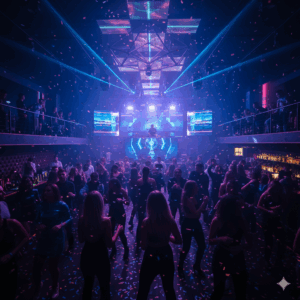
In contemporary Japanese nightlife, kyabakura venues are designed like “managed social rooms”: lounge-style seating, a clear reception flow, and staff-led pacing. Many are located near major stations, with bright signage at street level and a front desk that confirms your party size, time block, and seating type (main floor vs VIP room).
What actually happens inside is structured and predictable. A guest pays a base “set fee” for a fixed time (often 60 minutes), then chooses add-ons like nomination (requesting a specific hostess), VIP rooms, or extensions. The core experience is conversation, drink service, and a rotating or assigned seating model. Put simply: kyabakura japan is “institutionalized friendliness”—a staged closeness delivered through clear rules, time blocks, and menu-based pricing.
This format is popular for after-work socializing, business hosting, and travelers who want a guided, low-friction night out. You’ll see a wide age range among guests (often 20s–50s) and a split between quick weekday visits and longer late-night stays on weekends. Many shops now offer multiple contact options (phone, web form, LINE) and multilingual cues—especially in major areas like Kabukicho and Roppongi.
From an urban-cultural perspective, kyabakura turns “meeting strangers” into an organized service: greetings, seating, conversation prompts, and timekeeping are all professionalized. That’s why the system can feel surprisingly easy once you know the vocabulary.
1. Where should you start in kyabakura japan?

1-1 What kyabakura is (and isn’t)
Kyabakura is a paid social setting built around conversation, seating, and time. You pay for a time block (“1 set”), and the venue assigns (or rotates) a hostess to sit with you, manage the tone, and keep the experience moving. The business model is transparent: base seat time, then clearly-priced options like nomination, accompaniment, VIP rooms, and extensions.
A good way to learn the “shape” of the system is to read an official System page. For example, Kabukicho’s Hanabi shows a main-room set of 60 minutes and lists add-ons like nomination and extension on its official site:
Official website (Japanese).
1-2 A typical session flow
Most nights follow a consistent sequence:
- Reception confirms your party size, time block, and seating type.
- You’re seated, drinks are introduced, and the first conversation “rhythm” is set.
- Near the end of your set, staff asks about extension or closing the bill.
- If you nominate, extend, or move to VIP, the system updates and continues.
1-3 Cost drivers you control
Your final total is usually driven by: (1) your time (how many sets), (2) nomination (requesting a specific hostess), (3) VIP room fees, and (4) service charge/tax. You can keep things predictable by deciding your time cap upfront (e.g., “one set only”) and asking the staff to confirm the system before you start.
If you want to see an “early vs late” pricing pattern, Club RIO Roppongi publishes different main-room prices for 20:00–20:59 versus later hours on its official system page:
Official website (Japanese).
2. How do you access top areas?

2-1 Tokyo hubs: Kabukicho and Roppongi as “first stops”
For many visitors, Tokyo’s first-time-friendly hubs are Kabukicho (Shinjuku) and Roppongi. They have dense nightlife, clear taxi availability, and many venues that publish system menus online.
Kabukicho example: Hanabi lists multiple station walk times—JR Shinjuku East Exit and other nearby lines—on its official top page:
Official website (Japanese).
Roppongi example: UNJOUR Tokyo publishes address and business hours on its official site:
Official website (Japanese).
2-2 Major city clusters across Japan
If you’re traveling beyond Tokyo, kyabakura clusters also stand out in:
- Osaka (Kitashinchi) — business-oriented nightlife with many official contact pages and set-based pricing.
- Nagoya (Nishiki / Sakae) — station-dense area with high-end multi-floor venues.
- Sapporo (Susukino) — strong late-night culture and many “new club” style venues.
- Fukuoka (Nakasu) — large venues with clear system menus and group-friendly plans.
- Naha (Matsuyama) — compact area; walkable routes and early opening hours are common.
Osaka example: Club ECHOES publishes a full Access page (walk time) on its official site:
Official website (Japanese).
Fukuoka example: Club Hana Sakura publishes a detailed System page and is centered in Nakasu:
Official website (Japanese).
Naha example: CLUB NAHA includes access details such as a station walk time on its official page:
Official website (Japanese).
2-3 Planning around trains, taxis, and pacing
The simplest way to avoid stress is to plan your “last decision point” before you enter. If you want a short visit, go earlier and do one set. If you want a longer night, pick an area where it’s easy to move between venues on foot.
Table 2: Access & Hours
| Station | Walk Time | Hours | Area (JP Link) |
|---|---|---|---|
| JR Shinjuku Station (East Exit) | 6 min | 20:00–LAST | Official website (Japanese) |
| Subway Sakae Station (Exit 1) | 3 min | 20:00–LAST | Official website (Japanese) |
| Kitashinchi Station | 4 min | 20:00–25:00 | Official website (Japanese) |
| Nakameguro Station (South Gate) | 30 sec | 20:00–LAST | Official website (Japanese) |
| Kencho-mae Station (Yui Rail) | 7 min | 19:00– (Open year round) | Official website (Japanese) |
| JR Tachikawa Station (South Exit) | 2 min | 19:00–LAST | Official website (Japanese) |
Notes: “LAST” is commonly used on official pages to indicate a flexible late-night closing time. Use official Access/Top pages to confirm station exits and walk times before you go.
3. What should you budget for prices, time, and eligibility?

3-1 Set fees and time blocks
The most common “unit” is a set (often 60 minutes). Official pages show how prices vary by time and room type:
- Kabukicho Hanabi: main room set fee is listed as 60 minutes with extensions and an SOC add-on on the official page:
Official website (Japanese). - UNJOUR Tokyo: set fee starts at ¥15,000 (60 min), with extensions and VIP options shown on the official site:
Official website (Japanese). - Club RIO Roppongi: main room shows ¥10,000 (60 min) early and ¥14,000 (60 min) later on its system page:
Official website (Japanese). - Club ECHOES (Kitashinchi): lists a set of ¥9,000 (60 min) on its system page:
Official website (Japanese). - Club Hana Sakura (Nakasu): shows a 1-person set at ¥9,000–¥10,000 (60 min) depending on the hour, plus group pricing:
Official website (Japanese).
3-2 Service charge and tax (the part many first-timers miss)
Many venues post service charge and consumption tax separately from base fees. This is not “hidden”; it’s usually written clearly on the System page. The practical takeaway is: don’t budget only the set fee—budget set fee + options + posted percentages.
Examples from official pages:
Hanabi posts tax 10% and service 30% (separately) on its system section,
while Club RIO Roppongi posts service 30% and consumption tax 10% on its system page.
(See official links above.)
Table 4: Common Add-ons You’ll See on Menus
| Menu Item | Example Amount | What it means in practice | Official (JP Link) |
|---|---|---|---|
| Service charge + tax | 30% + 10% | Percentages added to the bill where posted; budget a buffer. | Official website (Japanese) |
| Nomination (request a specific hostess) | ¥3,000 | Locks in a specific person instead of a rotating assignment. | Official website (Japanese) |
| Extension fee | ¥4,500 (30 min) | Extends your set time; usually charged per block. | Official website (Japanese) |
| VIP room charge | ¥40,000 (60 min) | Private room fee on top of the base experience; varies by room type. | Official website (Japanese) |
| “Snack” style set (budget option) | ¥2,980 (60 min) | Lower-cost social drinking; still time-based and menu-driven. | Official website (Japanese) |
Notes: Always read the official “SYSTEM” section for posted percentages and room charges. ※参考情報(editor’s note):Some venues apply tax after service charge; totals can vary. If you want a hard cap, tell staff your budget before you start.
3-3 Eligibility, party size, and VIP rules
Eligibility is usually “adults only,” with ID checks possible. Dress codes range from casual-smart to formal depending on the venue. If you’re unsure, aim for clean shoes, long pants, and a collared shirt or neat top—especially in Roppongi and Kitashinchi.
Party-size rules can appear directly on official pages. UNJOUR Tokyo, for example, notes VIP conditions such as “VIP is available from 1 person” and a VIP charge per person on its system page:
Official website (Japanese).
4. Which venue types and services fit your style?

4-1 Standard kyabakura vs “new club” vs casual options
In everyday language, “kyabakura” can include a spectrum:
- Standard kyabakura: clear set fees, nomination options, and frequent station-access publishing (Kabukicho, Ikebukuro, Nishiki).
- New club / VIP-forward: more private-room structures and higher room charges (Roppongi, Kitashinchi, Nakasu).
- Snack / girls bar: lighter entry fees and a more casual, friend-group feel—still time-based and menu-driven.
4-2 Services that change the experience (and the bill)
The “feel” of the night changes more from options than from the base set. Nomination makes the experience more consistent (same hostess), while VIP rooms create privacy and slower pacing. Many official pages list these options openly:
- Club RIO Roppongi lists VIP room charges and time blocks on its official system page: Official website (Japanese).
- LANCER (Nagoya Nishiki) lists nomination, helper/additional fees, and VIP room conditions on its official top page: Official website (Japanese).
- Club Hana Sakura (Fukuoka Nakasu) lists separate pricing for 1 person vs 2+ people and mentions group plans on its system page: Official website (Japanese).
4-3 What “institutionalized intimacy” looks like (anthropology in plain English)
Kyabakura turns the uncertainty of nightlife into a professional script. Instead of guessing “how to talk” or “how to leave,” the venue supplies structure: timed sets, clear add-ons, and staff-led transitions. This is why the experience often feels safe and easy—even though you’re meeting strangers. The “intimacy” is not accidental; it’s engineered through seating design, hostess rotation or nomination, and a bill format that rewards time-based attention.
If you want a quick comparison of venue types with real numbers, use the table below and click through to the official pages. (Each row points to a first-party page that actually posts a system menu.)
Table 1: Venue Types & Base Fees
| Venue Type | Typical Fee | Session Time | Area (JP Link) |
|---|---|---|---|
| Standard kyabakura (Kabukicho) | ¥12,000 (main room set) | 60 min | Official website (Japanese) |
| VIP-forward kyabakura (Roppongi) | ¥15,000 (set) | 60 min | Official website (Japanese) |
| Premium kyabakura with time-tier pricing (Roppongi) | ¥10,000–¥14,000 (main room) | 60 min | Official website (Japanese) |
| Large-venue “new club” style (Fukuoka Nakasu) | ¥9,000–¥10,000 (1 person) | 60 min | Official website (Japanese) |
| Girls bar (casual alternative) | ¥5,400 (ALL TIME 60 min) | 60 min | Official website (Japanese) |
| Snack (budget-friendly, social) | ¥2,980 (set) | 60 min | Official website (Japanese) |
Notes: Fees above are “menu-listed examples” from official pages and may not include separate service charge/tax unless stated as included. Use the linked official pages to confirm what is included in the displayed price.
5. How do reservations, etiquette, and useful phrases work?

5-1 Reservations: the three most common routes
Reservations reduce waiting and make the first minutes smoother. On official pages, you’ll typically see:
- Web form: good for specifying date/time and人数 (party size).
- Phone: fastest for same-day confirmation.
- LINE: common for quick, casual booking messages.
Table 3: Reservation & Eligibility
| Method | Lead Time | Eligibility | Official (JP Link) |
|---|---|---|---|
| Web inquiry form | Same-day to advance booking | Adults-only venues; bring ID if requested | Official website (Japanese) |
| Web reservation form | Best for specifying人数 (party size) | Adults-only venues; confirm time block | Official website (Japanese) |
| Phone | Fastest for immediate confirmation | Adults-only venues; confirm set length | Official website (Japanese) |
| LINE message | Convenient for short booking messages | Adults-only venues; share name + time | Official website (Japanese) |
| LINE message | Convenient for repeat visits | Adults-only venues; ask about VIP | Official website (Japanese) |
Notes: Methods differ by venue. Use the official page’s contact section (phone/form/LINE) and keep your message simple: date, time,人数, and whether you want nomination.
5-2 Etiquette that keeps the night smooth
Kyabakura etiquette is mostly “make the system easy for staff.” If you’re polite and clear, the venue can deliver exactly what you want.
- Confirm the system upfront: set length, extension style, service charge and tax.
- Be time-aware: if you want one set only, say so early.
- Ask before taking photos: many venues prefer no photos on the floor.
- Stay respectful: the experience is conversation-led hospitality; treat it as such.
Some official pages explicitly show how extensions are handled (for example, automatic extension is mentioned on LANCER’s page). If you prefer confirmation each time, ask staff when you enter:
Official website (Japanese).
5-3 Useful Japanese phrases (copy/paste friendly)
Use short, polite phrases. Staff are used to these questions.
- System check: 「システムを教えてください。」(Shisutemu o oshiete kudasai.)
- One set only: 「今日は1セットだけでお願いします。」(Kyō wa 1 setto dake de onegai shimasu.)
- How much total?: 「だいたい、いくらぐらいになりますか?」(Daitai, ikura gurai ni narimasu ka?)
- Nomination: 「指名できますか?」(Shimei dekimasu ka?)
- Extension: 「延長します。」(Enchō shimasu.) / 「延長しません。」(Enchō shimasen.)
- Check: 「お会計お願いします。」(Okaikei onegai shimasu.)
6. Summary and Next Steps
Planning a night in kyabakura japan is easy once you stop thinking of it as “mysterious nightlife” and start treating it like a menu-based service. The real challenge for travelers and newcomers is not the experience itself—it’s the friction around choosing the right area, understanding set fees, and booking smoothly without language stress. That’s where SoapEmpire helps.
SoapEmpire organizes kyabakura information in plain English with the details that matter: typical set fees, nomination options, VIP room patterns, and access notes for major nightlife hubs like Kabukicho and Roppongi. Instead of reading dozens of pages, you can follow a simple flow: pick your vibe, pick your budget, and pick your time block. We also explain the “why” behind the system—how staged conversation and timekeeping create a predictable, comfortable night—so you can participate confidently without overthinking.
Our strength is practical selection support across Japan (Tokyo, Osaka, Nagoya, Fukuoka, and more), with clear guidance on hostess club norms, pricing language, and reservation steps. If you want help booking—especially when a venue prefers Japanese contact—SoapEmpire offers 24-hour booking support for only $10. You send us the venue name, your preferred time, and your name (nickname is fine), and we handle the booking process so you can focus on enjoying the night.
Use these internal guides to continue: Tokyo Kyabakura Guide, Osaka Nightlife Guide, and How to Book (Step-by-step). You can also explore the main site at SoapEmpire.
For reservations or inquiries, please contact us via the inquiry form.
6-1 A simple 5-step checklist
- Pick an area (Kabukicho / Roppongi / Kitashinchi / Nishiki / Nakasu, etc.).
- Read one official SYSTEM page and note: set time, extension fee, nomination fee, service/tax.
- Decide your cap: “one set only” or “two sets max.”
- Reserve (phone/LINE/web form) with date, time, and 人数.
- At reception, confirm: “system + add-ons + whether extension is automatic.”
6-2 Sample planning patterns by budget and style
Here are three “no-drama” patterns (adjust using official pages):
- Beginner, one-hour taste: early entry + 1 set + no nomination. (Use a venue with clear early pricing like official system page.)
- Social night with consistency: 1–2 sets + nomination once. (Example nomination is posted on official page.)
- Business hosting: VIP room + defined time cap + clear per-person rules. (See VIP details on official system page.)
6-3 FAQ
Q1) What is a realistic first-time budget?
A realistic plan is “one set + small buffer for posted service/tax.” Many official pages show 60-minute set pricing clearly (e.g., Hanabi, UNJOUR, Club RIO). Start with one set and decide on nomination only if you want consistency.
Q2) How do I book if I don’t speak Japanese?
Use the simplest channel shown on the official site: phone, a web form, or LINE. Keep your message short (date/time/人数). If you want assistance, SoapEmpire can support reservations via the inquiry form.
Q3) What time of day is best for a calm first visit?
Early hours are usually calmer and often cheaper. Some venues publish early/late pricing tiers (for example, Club RIO Roppongi’s system page). If you want “one set only,” go earlier and be explicit at reception.
Q4) Do I need to nominate someone on my first visit?
No. Nomination is optional. If you’re new, start without it, learn the flow, then nominate on a future visit once you know your preferred conversation style.
If you’re interested in visiting any of these places, SoapEmpire offers a 24-hour booking support service for only $10.
Just send the store name, preferred time, and your name (nickname is fine) to:
artistatakuma@icloud.com.
We’ll take care of your reservation quickly and smoothly.