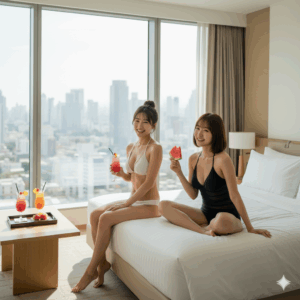
Start here: the fastest way to choose in Ikebukuro
Ikebukuro works because the supply is dense, the station is huge, and the hotels are spread across more than one usable cluster. The practical split is simple. The west and north side give you the biggest concentration and the easiest comparison walk. The east side is more convenient if your evening already ended around Sunshine City, the east-side shopping streets, or the park area. For first-timers, the smoothest route is usually to decide your use case first: short private break, long daytime stay, or overnight after missing the last train.
- Choose your use first: short stay, free time, or overnight.
- Pick the station side before comparing room photos.
- Assume busy late-night windows fill faster than daytime slots.
- Treat the posted starting rate as a floor, not the final total.
- Bring your passport for overnight use if you do not have a Japan address.
| Your plan | Best area fit | Time window to target | Budget signal | Main friction point |
|---|---|---|---|---|
| Two to three hours | North or west cluster | Daytime or early evening | Usually the cheapest entry | Missing the cutoff and rolling into extension fees |
| Long afternoon | West side or C6 access | Free-time window | Better value than repeated short-time charges | Entering too late for the long window |
| Overnight after the last train | West, north, or reserved east-side room | Before peak late-night rush | Rate jumps by day and room rank | Full occupancy and special-day pricing |
| Post-date near Sunshine | East side | Book ahead on weekends | Convenience can cost more than north-side budget picks | Less room to compare on foot |
Systems and areas: what the price words actually mean
Ikebukuro hotels often publish several overlapping systems. “Short time” is the smallest entry point. “Rest” usually means a fixed short daytime or evening block. “Free time” is the long daytime value play. “Stay” means overnight. The mistake many travelers make is assuming all of them work like a normal hotel night. They do not. You are buying a specific time window, and the window can differ by weekday, Friday, Saturday, holiday, or special period. The other local variable is area. North and west side properties usually give you more same-night inventory. East side properties can be easier after an east-side date, but you have fewer backup doors within a two-minute walk.
- Read the plan name before looking at room photos.
- Check whether the price is tied to a specific entry time.
- Look for “free time” if you want the best daytime value.
- Assume Saturday and holiday-eve rules are stricter.
- Use station exit fit as a real selection factor, not an afterthought.
| System type | Time unit | Price signal | Common add-ons | Friction points | Best for |
|---|---|---|---|---|---|
| Short time | 60 to about 130 minutes | Lowest entry price | Extension after cutoff | Easy to overrun | Checking how strict extension rules are |
| Rest | Usually 2 to 3 hours | Mid-low | Per-30-minute extension | Late-night switch to stay pricing | Comparing short private-use totals |
| Free time | Long daytime block | Strong value if you fit the window | Extension after the window closes | Entering too late | Checking long daytime use |
| Stay | Evening to next morning | Higher base, bigger weekday/weekend spread | Extensions, room upgrades, special-day premiums | Peak-night sellout | Checking last-train or overnight use |
| Room-rank stay | Same overnight window, different room grade | Wide price jump by rank | Higher extension fee in some cases | Cheapest room sold out first | Checking whether the lowest published rate is realistic |
Price and total cost: what changes the final number
In Ikebukuro, the safest reading of a rate page is this: the hotel is showing a starting point, often for the cheapest room grade, during a specific weekday pattern. Some properties publish one simple “from” price, while others publish several room bands. Extensions are the silent budget killer. Published examples in Ikebukuro range around ¥1,000 to ¥1,500 per 30 minutes, and that adds up quickly if you enter on a short plan and drift past the cutoff. Some hotels also flip you into a stay plan after a certain late-night hour. For travelers, this is the one section worth checking before you leave the station.
- Ask whether the price is per room or per person; many love hotels post per-room pricing.
- Check whether tax is already included on the page.
- Check the extension unit: 30 minutes is common.
- Check special-day rules for Fridays, Saturdays, and holiday eves.
- Do not assume the lowest published room grade will still be open.
| Base | Time | Extensions | Options | Fees | Where stated | What to confirm |
|---|---|---|---|---|---|---|
| Short-time starting rate | Usually 60 to 130 minutes | Often starts immediately after cutoff | Food, rental, special room | Possible late-night switch | Price grid or room-rank page | Exact checkout minute |
| Rest price | Commonly 2 to 3 hours | Often ¥1,000 to ¥1,500 per 30 min | Room grade changes total | Special-day surcharge possible | Official rate table | Lowest and highest room band for your entry time |
| Free-time price | Long daytime block | After the free-time window ends | Premium bath or entertainment room | Weekend rules may shorten window | Time-table section | Last valid entry time |
| Stay price | Evening to morning | Overstay charges after checkout | Early entry or late checkout in some systems | Cancellation charges on reserved plans | Stay plan section | Check-in start time and guaranteed stay length |
| Room-rank “from” price | Depends on plan | May scale with room grade | Higher rank, bigger jump | Lowest rank may be unavailable | Room-type page | What room grades are still open right now |
What to confirm before you go: eligibility, ID, payment
For travelers and expats, this is the section that prevents the most avoidable trouble. Love hotels generally operate with age restrictions. In practice, plan for 18 and over only, and do not assume that being 18 automatically overrides school-status restrictions. For overnight use, visitors without a Japanese address should be ready to show a passport. Payment is the next friction point. Some Ikebukuro properties openly list broad cashless support, while others are less clear on the public page. If you rely on a specific card or app, confirm it before arrival instead of at the counter. Finally, check whether outside re-entry is allowed. Some hotels allow it only after leaving the key at the front desk; others may be stricter.
- Assume 18+ only unless the hotel clearly states otherwise.
- Bring your passport for overnight use if you are visiting Japan without a local address.
- If you live in Japan, do not assume every front desk understands the ID rule the same way.
- Check card, QR, and e-money support before you head over.
- Check whether outside re-entry is allowed.
- Confirm smoking and guest-count rules if they matter to you.
| Item | Where to find | Typical wording | Why it matters |
|---|---|---|---|
| Age / minors | FAQ, house rules, column pages, small-print notes | 18 and over only / minors not accepted | This is a hard stop issue |
| Passport / ID | FAQ, check-in notes, reservation page | Passport required for non-resident foreign guests | Most relevant for overnight users |
| Accepted payment | Store information, price page, footer | Cash / credit card / PayPay / e-money | Avoids last-minute payment failure |
| Re-entry / going outside | FAQ or store details | Outside allowed with key left at front desk | Important if you plan to buy food or step out |
| Capacity / guest count | Room page or store information | 1 person, 2 people, or extra guest charge | Changes both eligibility and price |
| Cancellation for reservations | Reservation rules | Free until the day before / no-show charged | Relevant when booking ahead |
How it works on-site
For adult lodging in Ikebukuro, the real question is not whether the process is difficult. It usually is not. The question is where people hesitate. They hesitate at the room-choice screen, at the rate grid, and at the moment they realize the stay window is different from a normal hotel night. Walk-ins are common, but reserved plans are smoother on busy nights. Front-desk payment is still common at some Ikebukuro properties, and prepayment is openly listed by several named hotels in this area. During the stay, the one thing to track is time. If you plan to step out, ask before you do it, not after.
- Decide the plan before entering if possible.
- Check the room grade you are actually paying for.
- Confirm the exact checkout time.
- Keep track of extension increments.
- Ask about re-entry before leaving the room.
| Step | What happens | What causes friction |
|---|---|---|
| 1. Before entry | You decide walk-in or reservation check-in | No plan chosen, no idea which time block fits |
| 2. Room selection | You choose an available room or confirm your reserved one | Only higher room grades remain open |
| 3. Check-in and payment | Front desk or machine check-in, often prepay | Payment method mismatch, passport not ready for overnight stay |
| 4. During stay | You use the room within the purchased window | Forgetting cutoff time and entering extension territory |
| 5. Going outside | Some hotels allow it with front-desk handling | Assuming re-entry is automatic everywhere |
| 6. Checkout | Leave on time or pay extension / overstay difference | Thinking “a few minutes” is free |
Reservations and booking reality
Many people still picture love hotels as walk-in only. In Ikebukuro, that is outdated. Several properties now accept web reservations, phone reservations, and in some cases same-day web booking. That does not mean every room or every plan is reservable in the same way. The real booking rule is to reserve when the time matters. If you need a specific part of town, a specific arrival window, or a smooth overnight after the last train, reservation is worth it. If you are flexible and it is daytime, walking the cluster still works. The three details worth confirming when booking are total price, checkout time, and re-entry policy.
- Reserve when timing matters more than price.
- Use walk-in only when you can accept backups.
- Treat same-day web booking as a useful bonus, not a guarantee at every hotel.
- Ask for the total before you finalize.
- Ask whether the plan is tied to a specific arrival window.
| Channel | Works for | Good at | Weak point | What to confirm |
|---|---|---|---|---|
| Walk-in | Flexible daytime or backup-happy nights | Immediate entry if rooms exist | Cheapest room may be gone | Actual room total and cutoff time |
| Web booking | Planned stays and some day-use plans | Clearer price and cancellation rules | Not every room or time block is listed | Arrival window, cancellation, payment timing |
| Phone booking | Checking edge cases and same-day plans | Fast answers on total, ID, and re-entry | Language can be the friction point | Total price, room type, and check-in deadline |
| Same-day web booking | Peak hours when you need certainty | Better than wandering during sellout periods | Inventory changes fast | Whether your exact time block is still active |
Five named love hotel options in Ikebukuro
The point of this list is not to force one choice. It is to show how different Ikebukuro properties publish rates and rules. Some make payment and re-entry very clear. Some are better for access from a specific exit. Some are good because the published “from” rate is easy to understand. Others are useful because the hotel clearly supports advance booking. Use the table below as a comparison tool rather than a ranking.
- Match the hotel to your exit first.
- Read the “published start rates” as starting bands.
- Prefer properties with clearly posted payment methods if you are cashless-only.
- North-side hotels can be practical if you want a larger cluster to compare.
- East-side access matters if your night already ended there.
| Hotel | Area / walk | Published start rates | Booking | Payment | Useful note |
|---|---|---|---|---|---|
| Hotel Petit Bali Ikebukuro | West side; 5 min from west exit, 2 min from C6 | Day use from ¥3,900 / stay from ¥7,900 | Phone and web | Cash, cards, QR, e-money clearly listed | Front prepay, outside allowed, large room count |
| Hotel Balian Resort Forest Ikebukuro West | West side; 8 min from west exit | Day use from ¥5,800 / stay from ¥11,800 | Phone, web, and same-day web options | Cash, cards, QR, e-money clearly listed | Front prepay, outside allowed, parking cashback with proof |
| Hotel Parkside Ikebukuro | East side; about 3 min from station | Standard 120 min from ¥3,500 / stay from ¥6,900 | Web reservation link | Cash, cards, PayPay, iD, QUICPay | Good east-side convenience; higher grades step up fast |
| HOTEL CHECK INN BALI | North side; about 5 min from north exit / 20a | Short time around ¥3,200 / rest from about ¥4,950 / overnight from about ¥5,940 | Reservable on listing pages; phone contact published | Not clearly posted on the main public listing page | Best known for its long guaranteed stay logic |
| HOTEL LOTUS Ikebukuro | North side; 5 min from north exit | Service rank rest from ¥3,900 / stay from ¥7,900; standard from ¥5,900 / ¥9,900 | Net reservation and phone reservation shown | Payment methods not clearly posted on the main page | Wide room-rank spread, so confirm actual assigned room total |
Summary and next steps
If you only remember four checks, make them these: the exact time system, the total price for the actual room you will use, the payment method, and the ID expectation for your type of stay. Ikebukuro is forgiving because the area has depth. But it punishes assumptions. The room photo is not the first thing to trust. The price grid and store-info section are. Once those numbers and rules are clear, the rest becomes easy.
- Use north/west if you want more doors to compare.
- Use east side if your date or route already ends there.
- Reserve on Friday night, Saturday night, holiday eves, and event-heavy nights.
- Bring your passport for overnight use if you are visiting without a Japan address.
- Before paying, confirm the total and the checkout time.
| Scenario | What to check first | Why |
|---|---|---|
| Short private stop | Short-time or rest cutoff | This decides whether you stay cheap or trigger extensions |
| Long afternoon | Free-time window | It can save more than hunting for the lowest base rate |
| Missed last train | Reservation or live availability | Sellout risk rises late at night |
| Foreign traveler staying overnight | Passport and check-in notes | This is the most common avoidable check-in issue |
| Cashless-only user | Payment list on the store page | Not every property publishes broad support |
FAQ
Do I need to reserve a love hotel in Ikebukuro?
No, not always. Walk-in is still common, especially in daytime. But reservation is the safer move on Friday night, Saturday night, holiday eves, and nights when your time window matters.
Can foreign travelers use love hotels in Ikebukuro?
Yes, but for overnight use, travelers without a Japanese address should be ready to show a passport. It is better to assume you may be asked than to arrive unprepared.
Is the posted price per person or per room?
Many Ikebukuro love hotel rate pages are posted per room, often for up to two guests, but you must still confirm capacity and any extra-person charge on the hotel page.
Can I leave and come back after check-in?
Sometimes. Some hotels clearly allow outside re-entry after leaving the room key at the front desk. Do not assume that rule is universal.
What is the biggest mistake first-timers make?
Using the wrong time block. A cheap short plan becomes expensive fast if you miss the cutoff and roll into extension or overnight pricing.
Appendix: Useful phrases
| Japanese | Romaji | English |
|---|---|---|
| 空いている部屋はありますか? | Aite iru heya wa arimasu ka? | Do you have a room available now? |
| 休憩と宿泊の料金を教えてください。 | Kyūkei to shukuhaku no ryōkin o oshiete kudasai. | Please tell me the rest and stay prices. |
| 合計はいくらですか? | Gōkei wa ikura desu ka? | How much is the total? |
| 延長料金はいくらですか? | Enchō ryōkin wa ikura desu ka? | How much is the extension fee? |
| カードで払えますか? | Kādo de haraemasu ka? | Can I pay by card? |
| PayPayは使えますか? | PayPay wa tsukaemasu ka? | Can I use PayPay? |
| 外出して戻れますか? | Gaishutsu shite modoremasu ka? | Can we go out and come back? |
| パスポートは必要ですか? | Pasupōto wa hitsuyō desu ka? | Do I need my passport? |
| チェックアウトは何時ですか? | Chekkuauto wa nanji desu ka? | What time is checkout? |
| 今夜の予約はできますか? | Kon’ya no yoyaku wa dekimasu ka? | Can I make a reservation for tonight? |
Category: CATEGORY_ADULT_LODGING
SEO Title: Love Hotels in Ikebukuro | Prices, Booking, and Entry Rules
Alternate Titles:
Ikebukuro Love Hotels: Prices, Rules, and Booking Reality
Love Hotels in Ikebukuro: Cost, ID, and Booking Basics
Ikebukuro Love Hotel Guide: Prices, Access, and Check-In Rules
Meta description: A practical guide to love hotels in Ikebukuro covering prices, stay types, booking reality, ID rules, payment checks, and five named examples.
Slug: love-hotels-in-ikebukuro
Primary keyword: love hotels in ikebukuro
Secondary keywords: ikebukuro love hotel prices, ikebukuro love hotel booking, ikebukuro adult hotel, ikebukuro rest stay free time, ikebukuro hotel passport rule, ikebukuro north exit love hotel, ikebukuro west exit love hotel, ikebukuro east exit love hotel
Key takeaways:
1. In Ikebukuro, the time system matters more than the brand name.
2. The final total changes most often because of room rank, entry window, and extension fees.
3. The cleanest check-in comes from confirming total price, checkout time, ID expectations, and payment method before arrival.
::contentReference[oaicite:0]{index=0}