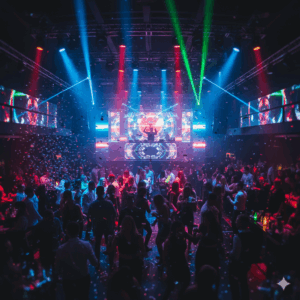
This guide explains how to plan a Shinjuku dance club night using official venue and facility information (fees, hours, access, and reservation methods).
You’ll also get a simple phrase list and an action plan you can use tonight.
How Shinjuku club spaces work (in plain words)
Shinjuku’s dance venues are part of a wider “night economy” that is designed around efficient movement: station exits → bright main streets → a concentrated nightlife core → controlled entrances. Inside, most places use a predictable flow: ID check, ticket/wristband, lockers or cloak, then multiple “micro-spaces” (main dance floor, bar corners, lounge seating, VIP tables). The point is not mystery—it’s coordination.
In ethnographic terms, Shinjuku’s club scene is a form of institutionalized social contact: the venue provides music, lighting, and crowd rhythm; guests perform “being out” through dancing, small talk, and shared movement; and rules (age checks, dress guidance, payment systems) keep that contact predictable. It’s nightlife as a structured urban ritual—especially around Kabukicho and Shinjuku-sanchome.
For official references used in this guide, see the venue pages for ZEROTOKYO (official website, Japanese), WARP SHINJUKU (official website, Japanese), and DJ BAR Bridge Shinjuku (official website, Japanese).
Table of Contents
1. Where should you start in Shinjuku dance club nightlife?
1-1. Three beginner-friendly “scales” in Shinjuku
Shinjuku has multiple nightlife “formats,” but for dance-focused nights you’ll usually pick one of these:
Mega club (large multi-floor entertainment complex), multi-floor nightclub (genre switching by floor/time), or DJ bar (smaller dance floor, close-to-the-DJ vibe).
For example, ZEROTOKYO positions itself as a Kabukicho “night entertainment” hub on its official site:
ZEROTOKYO (official website, Japanese).
1-2. Why Shinjuku feels different from other Tokyo club areas
Shinjuku’s nightlife density is unusual because major transport hubs (multiple rail lines and subways) feed directly into a concentrated entertainment zone.
Kabukicho is the best-known nightlife core, while Shinjuku-sanchome (a short distance away) supports a bar-to-DJ-bar flow.
The “gateway” idea appears even in venue branding—DJ BAR Bridge Shinjuku calls itself a “new playground” in Shinjuku:
DJ BAR Bridge Shinjuku (official website, Japanese).
Practically, that means you can do a “two-stop” night without complex transit:
one large venue for peak energy and one smaller room for more conversational dancing.
1-3. The standard club “flow” you’ll see at Shinjuku entrances
Most Shinjuku dance venues use the same choreography of entry:
(1) arrival and queue, (2) ID check, (3) payment and a wristband/drink ticket, (4) lockers or cloak, (5) floor selection.
Two official examples:
ZEROTOKYO states it is cashless inside (lockers excepted) on its System page:
ZEROTOKYO System (official website, Japanese).
WARP SHINJUKU outlines entrance fees and age limit rules on its System page:
WARP SHINJUKU System (official website, Japanese).
2. How do you reach the best areas and entrances?
2-1. Kabukicho Tower as a navigation anchor
If your plan includes ZEROTOKYO, your easiest navigation anchor is Tokyu Kabukicho Tower.
The facility’s official Access page lists walking times from major stations—this is exactly the kind of “decision-friendly” data you want before leaving your hotel:
Tokyu Kabukicho Tower Access (official website, Japanese).
ZEROTOKYO also publishes its own access details (address and station walking times) on its official Access page:
ZEROTOKYO Access (official website, Japanese).
2-2. Shinjuku-sanchome for DJ-bar style nights
For a smaller, DJ-led room, Shinjuku-sanchome is a practical base.
DJ BAR Bridge Shinjuku has an official schedule post that states it is located just 20 seconds from Shinjuku-sanchome Station:
DJ BAR Bridge Shinjuku schedule post (official website, Japanese).
Bridge also publishes a clear address and phone contact on its Access page:
DJ BAR Bridge Shinjuku Access (official website, Japanese).
2-3. A simple “one-night route” that avoids confusion
A low-stress Shinjuku plan is to start at a landmark with published station walking times (Kabukicho Tower),
then move to a nearby bar/DJ bar area (Shinjuku-sanchome).
This reduces navigation friction and keeps your night flexible.
Table 1: Access & Hours
| Station / Landmark | Walk Time | Hours (official wording) | Area (JP Link) |
|---|---|---|---|
| Seibu-Shinjuku Station → Tokyu Kabukicho Tower | 1 min | (Facility access info page) | Official website (Japanese) |
| Shinjuku Station → Tokyu Kabukicho Tower | 7 min | (Facility access info page) | Official website (Japanese) |
| Shinjuku-sanchome Station → Tokyu Kabukicho Tower | 8 min | (Facility access info page) | Official website (Japanese) |
| Shinjuku-sanchome Station → DJ BAR Bridge Shinjuku | 20 sec | Event-specific postings often show OPEN: 21:00 (varies) | Official website (Japanese) |
Notes: Walk times are shown exactly as published on official access/event pages. Hours can vary by event; always confirm the day’s listing on the official schedule.
3. What do prices, time slots, and age rules look like?
3-1. Typical Shinjuku nightclub fee patterns (time bands)
Many Shinjuku nightclubs use “time bands,” meaning the entry fee changes depending on when you arrive.
WARP SHINJUKU publishes a clear pattern: fees differ for earlier vs later entry (for example, “OPEN–23:00” and “23:00–04:30” time slots) on its System page:
WARP SHINJUKU System (official website, Japanese).
3-2. Event-based pricing (common at mega venues)
Some Shinjuku dance floors price by event rather than a fixed nightly system.
For a concrete example, ZEROTOKYO’s official event listing for “Butterfly Effect 1st Anniversary” shows:
the conclusion first—this night’s door price is ¥4,200 and it opens at 11PM—then the official source:
ZEROTOKYO event page (official website, Japanese).
This is why your plan should start with the music/event you want (techno, bass, open format, etc.), then you confirm the exact price and opening time on the official event page.
3-3. Age limit, ID checks, and payment systems
Large dance venues in Shinjuku commonly require adult entry and photo ID checks.
ZEROTOKYO’s official FAQ states that for normal club-time events, entry under 20 is not accepted and ID presentation is required:
ZEROTOKYO FAQ (official website, Japanese).
WARP SHINJUKU publishes similar age-limit guidance on its official pages:
WARP SHINJUKU System (official website, Japanese).
Also note the payment style: ZEROTOKYO states it is a cashless venue inside (except coin lockers), so your “go/no-go” decision should include whether you have usable cards or e-money:
ZEROTOKYO System (official website, Japanese).
Table 2: Venue Types & Base Fees
| Venue Type | Typical Fee | Session Time | Area (JP Link) |
|---|---|---|---|
| Mega club (event-based, multiple floors) | Example conclusion: door ¥4,200 (event listing) | Example conclusion: 11PM open (event listing) | Official website (Japanese) |
| Multi-floor nightclub (time-band pricing) | Example conclusion: men ¥2,000 before late slot / men ¥4,000 later slot (varies by day) | Example conclusion: late slot runs to 04:30 | Official website (Japanese) |
| DJ bar (smaller room, close-to-DJ) | Example conclusion: some events show door ¥2,000 (event post) | Example conclusion: doors open at 21:00 (news) | Official website (Japanese) |
Notes: “Typical” here means “officially published examples.” Mega venues often price per event; nightclubs often price by arrival time band; DJ bars may publish event-by-event door info.
4. Which venue types fit your style of dancing?
4-1. Mega club nights: “one building, many worlds”
Mega venues are built for exploration: multiple floors, multiple moods, and a sense of spectacle.
In practice, this means you can “reset” your night by changing floors instead of leaving the building.
ZEROTOKYO’s official pages emphasize event schedules and clearly publish access and system rules:
ZEROTOKYO Event Schedule (official website, Japanese),
ZEROTOKYO Access (official website, Japanese).
Ethnographically, the building acts like a curated city at night: each floor offers a different “script” for how to dance, socialize, and take breaks—so you can pick the level of intensity you want.
4-2. Multi-floor nightclub nights: time zones + floor genres
WARP SHINJUKU is a good example of a nightclub that describes itself through floors and time changes.
Its official English guide says it has 4 floors with different genres and also states it is open from 9pm to 5am:
HOW TO WARP (official website, Japanese/English).
If you like a night that “builds” (warm-up → peak → late), this format matches your rhythm.
It also pairs well with time-band fees (arrive earlier for one vibe, later for another), as shown on the WARP System page:
WARP SHINJUKU System (official website, Japanese).
4-3. DJ bar nights: tighter dance floors, more conversation
A DJ bar is often the best fit if you want to dance but still talk without leaving the room.
DJ BAR Bridge Shinjuku’s official top page frames the venue as a “new playground” and shows ongoing schedules:
DJ BAR Bridge Shinjuku Top (official website, Japanese).
Bridge also publishes a clear notice that doors open at 21:00 (9PM) from March 3 (as announced), plus an early-arrival drink ticket campaign:
DJ BAR Bridge Shinjuku news post (official website, Japanese).
5. How do reservations, etiquette, and phrases work?
5-1. VIP reservations: the official methods you can rely on
VIP is the most “reservable” part of Shinjuku clubbing.
ZEROTOKYO’s official VIP page states VIP reservations can be made by:
online (via each event page, 24/7), phone (Wed–Sun, 8:00 PM – 2:00 AM), and LINE (same hours):
ZEROTOKYO VIP (official website, English).
WARP SHINJUKU also provides official guidance for enjoying the venue and mentions re-entry ticket details in its HOW TO page (for example, re-enter ticket 800 yen is referenced there):
HOW TO WARP (official website, Japanese/English).
5-2. Etiquette that keeps your night smooth
Shinjuku club etiquette is mostly about keeping the flow easy for everyone:
have your ID ready at the entrance, keep payment quick, use lockers if you have a bag, and follow staff guidance on where to queue.
ZEROTOKYO publishes ID check rules and the cashless policy on its official System page:
ZEROTOKYO System (official website, Japanese).
WARP SHINJUKU publishes typical entrance rules (age limit, ID check, and general guidance) across its System and FAQ pages:
WARP SHINJUKU System (official website, Japanese),
WARP SHINJUKU FAQs (official website, Japanese).
5-3. Quick Japanese phrases that actually get used
Table 3: Reservation & Eligibility
| Method | Lead Time | Eligibility | Official (JP Link) |
|---|---|---|---|
| ZEROTOKYO VIP: Online reservation via event pages | Conclusion: 24/7 (official VIP info) | Conclusion: entry is 20+ with ID checks (official rules/FAQ) | Official website (Japanese) |
| ZEROTOKYO VIP: Phone / LINE reservation | Conclusion: Wed–Sun 8:00 PM–2:00 AM | Bring photo ID for entry checks (official rules/FAQ) | Official website (Japanese) |
| WARP: Check fees, then walk-in / VIP options | Same-day is possible; confirm timing bands first | Conclusion: entry is generally 20+ with ID check | Official website (Japanese) |
Notes: Walk-in is common for general entry. VIP has clearer official channels; use the venue’s own VIP/system pages rather than third-party summaries.
Table 4: Useful Phrases Quick Ref
| Situation | Japanese | Simple English meaning | Official (JP Link) |
|---|---|---|---|
| Asking about entry fee | 入場料はいくらですか? | “How much is the admission fee?” | Official website (Japanese) |
| Showing ID | 身分証あります。 | “I have my ID.” | Official website (Japanese) |
| Asking about cashless payment | 現金は使えますか? | “Can I use cash?” | Official website (Japanese) |
| Confirming opening time | 何時オープンですか? | “What time do you open?” | Official website (Japanese) |
Notes: These phrases are short, polite, and common. Keep your phone ready to show event pages if you’re confirming the day’s details.
6. Summary and Next Steps
Planning a Shinjuku dance club night sounds easy until the real questions show up: Which area is the simplest to navigate? What time should you arrive to match the music and the fee “time bands”? Will the night be event-based pricing or a fixed system? And if you want VIP tables, what’s the correct reservation channel—without getting lost in unofficial summaries?
This is where SoapEmpire helps you turn information into a workable plan. We organize Shinjuku nightlife in plain English using clear categories like nightclub vs DJ bar, and we focus on the practical points travelers need: Kabukicho access (including station walking times), admission fees, and VIP table options. Instead of guessing, you can cross-check official pages—like ZEROTOKYO event listings for exact door prices and opening times, or WARP’s system page for time-slot fees—and then decide your route with confidence.
SoapEmpire’s advantage is how we package the details: we cover Kabukicho and surrounding areas across Tokyo, and we keep the “decision order” consistent—plan → numbers → official reference. That makes it easier to choose the right night for your style, whether you want a big multi-floor nightclub experience, a closer-to-the-DJ DJ bar room, or a VIP-focused evening with VIP tables. We also provide nationwide coverage (Tokyo, Osaka, Nagoya, Fukuoka) and English-friendly guidance on venue systems, basic etiquette, and what to prepare before you arrive.
Most importantly, if you want your night to run smoothly, SoapEmpire offers 24-hour booking support for only $10. That means you can send us your preferred venue and time, and we’ll help you handle the reservation steps in a straightforward way—especially useful for VIP plans and busy weekends. You can explore our site at SoapEmpire, and when you’re ready:
For reservations or inquiries, please contact us via the inquiry form.
6-1. A simple action plan you can use tonight
- Decide your “scale”: mega club (event-based), nightclub (time-band fees), or DJ bar (smaller room).
- Confirm access and walking times from official pages (start with Kabukicho Tower access):
Tokyu Kabukicho Tower Access (official website, Japanese). - Check the day’s pricing and opening time on official listings:
ZEROTOKYO Event Schedule (official website, Japanese) /
WARP System (official website, Japanese). - Prepare ID and your payment method (especially if the venue is cashless inside):
ZEROTOKYO System (official website, Japanese). - Keep one nearby backup: a DJ bar option with quick station access (e.g., Bridge near Shinjuku-sanchome):
DJ BAR Bridge Shinjuku Access (official website, Japanese).
6-2. SoapEmpire internal guides (read next)
- Shinjuku nightlife guide (area-by-area)
- Tokyo nightclub guide (venue types and budgets)
- How to book nightlife in Japan (simple steps)
6-3. FAQ
Q1) How much should I budget for a Shinjuku dance club night?
Plan first, then numbers: if you’re going to an event-based venue, the door price can be clearly listed per event (example: ¥4,200 on a ZEROTOKYO event page), plus your drinks. Source:
ZEROTOKYO event page (official website, Japanese).
Q2) Do I need a reservation to enter?
Usually no for general entry; walk-in is common. Reservations matter most for VIP tables. ZEROTOKYO publishes VIP methods (online 24/7 via event pages; phone/LINE 8:00 PM–2:00 AM on Wed–Sun). Source:
ZEROTOKYO VIP (official website, English).
Q3) What ID rules should I expect?
Expect adult entry rules and photo ID checks at major venues. ZEROTOKYO’s official FAQ states normal club-time events do not accept under-20 entry and require ID presentation. Source:
ZEROTOKYO FAQ (official website, Japanese).
If you’re interested in visiting any of these places, SoapEmpire offers a 24-hour booking support service for only $10.
Just send the store name, preferred time, and your name (nickname is fine) to:
artistatakuma@icloud.com.
We’ll take care of your reservation quickly and smoothly.
“`
::contentReference[oaicite:0]{index=0}