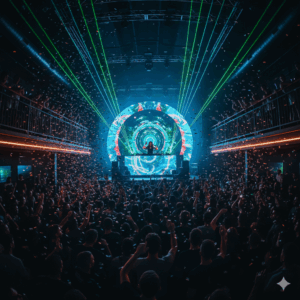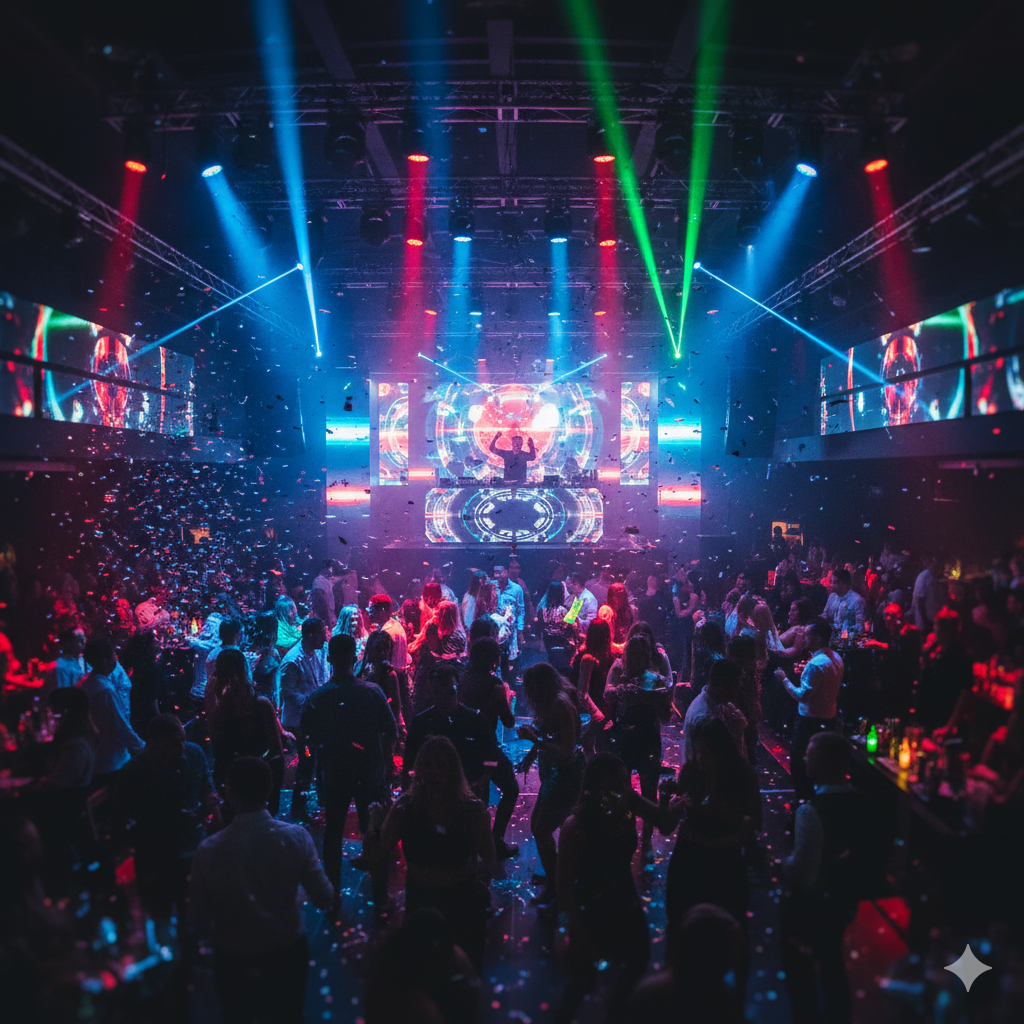
Expect time-band pricing (earlier is cheaper), ID checks, and simple rules that keep the crowd flowing.
This guide explains where to start, how to get there, what to budget, and the phrases that make the door feel easy.
This article focuses on the modern space design of a Shinjuku dance club night: multi-floor rooms, clear entrance routes, loud-and-bright “main hall” staging, and a predictable sequence of steps (queue → ID check → fee/drink ticket → locker → floor).
In Shinjuku, this is not just entertainment; it is an urban routine that turns crowd movement into a structured experience.
A typical club in the area is organized like a small building: an entrance desk that handles admission, a bar system that often includes a first drink, lockers and cloak spaces that prevent bags from blocking passages, and one or more rooms that let you switch genres without changing venues.
If you aim for Kabukicho (the area around the big neon streets), you will also find large-scale venues tied to major entertainment complexes such as Tokyu Kabukicho Tower, which hosts ZEROTOKYO as a flagship night entertainment tenant:
Tokyu Kabukicho Tower: ZEROTOKYO (Japanese).
The “service” in this context is not a private transaction; it is staged proximity: lighting cues, DJ transitions, staff guidance at chokepoints, and time-banded admission that shapes when the room fills.
Foreign visitors will notice that the rules are explicit and repeated (ID, dress, entry flow), which makes a first night easier once you know the pattern.
Table of Contents
1. Where should you start in a Shinjuku dance club night?
2. How do you reach top areas and club entrances in Shinjuku?
3. What do prices, time slots, and eligibility look like?
4. Which venue types and in-club services fit your style?
5. How do reservations, etiquette, and useful phrases work?
1. Where should you start in a Shinjuku dance club night?
1-1. What makes Shinjuku’s club scene feel different?
Shinjuku nightlife feels compact because transit, signage, and entertainment are stacked close together.
A clear example is Tokyu Kabukicho Tower, where night entertainment is placed inside a major complex rather than hidden behind side streets:
Tokyu Kabukicho Tower: Night entertainment (Japanese).
This “complex-based” layout changes behavior: you enter a building with a defined route, not a maze of small doors.
The result is a staged transition: street noise → lobby/queue → ID check → ticket/fee → locker → floor.
Even first-time visitors can follow the flow because the venue itself is designed for crowd circulation.
1-2. What is the typical flow from entrance to dance floor?
Expect a predictable entrance choreography. Many Shinjuku clubs publish clear rules about ID checks and entry conditions.
For example, ZEROTOKYO states that standard club-time events are for ages 20+ and require ID at the entrance:
ZEROTOKYO FAQ (Japanese).
Once inside, the floor design is about controlled proximity: the dance floor concentrates movement, bars spread people out, and staff manage bottlenecks so the room can stay energetic without becoming chaotic.
1-3. How do you choose between Kabukicho and Shinjuku-sanchome?
Choose Kabukicho if you want a landmark-based route and a “large venue” atmosphere.
Choose Shinjuku-sanchome if you want an alternative approach and easier transitions to dining or bars before entering a club.
If you plan to start from Shinjuku Station, it helps to understand its scale; JR East provides official station maps and facility info:
JR East: Shinjuku Station information (Japanese).
※参考情報(editor’s note): Many visitors do “Kabukicho first, then branch out” because landmarks simplify navigation late at night, especially when multiple friends arrive at different times.
2. How do you reach top areas and club entrances in Shinjuku?
2-1. How do you get from Shinjuku Station to Kabukicho Tower?
If Kabukicho Tower is your anchor (for venues like ZEROTOKYO), the simplest planning method is: “Which station am I coming from, and what is the walk time?”
Tokyu Kabukicho Tower publishes official walk times from nearby stations:
Seibu-Shinjuku Station in 1 minute, Shinjuku-nishiguchi Station in 6 minutes, JR Shinjuku Station in 7 minutes, and Shinjuku-sanchome Station in 8 minutes.
Source:
Tokyu Kabukicho Tower Access (Japanese).
2-2. Which stations are easiest for ZEROTOKYO access?
ZEROTOKYO’s official access page lists the same practical walk times: Seibu-Shinjuku 1 minute, JR Shinjuku 7 minutes, and Shinjuku-sanchome 8 minutes.
Source:
ZEROTOKYO Access (Japanese).
This kind of publication matters: you can set expectations for meeting friends (“Let’s meet at the tower, 7 minutes from JR Shinjuku”), rather than navigating by vague neighborhood names.
2-3. How do you approach WARP and ATOM by official location info?
WARP SHINJUKU publishes its Kabukicho address on its access page:
WARP SHINJUKU Access (Japanese).
ATOM SHINJUKU publishes its Shinjuku address and nearby station names on its official site:
ATOM SHINJUKU Official Site (Japanese).
※参考情報(editor’s note): For meeting points, the most reliable method is to choose one “anchor” location (tower entrance, a specific exit, or a named building), then move together to the club entrance.
Table 2: Access & Hours
| Venue / Anchor | Closest Station | Walk Time | Published Hours / Time Band | Official (JP Link) |
|---|---|---|---|---|
| Tokyu Kabukicho Tower (anchor for ZEROTOKYO) | Seibu-Shinjuku Station | 1 min | Parking is listed as 24 hours (building info) | Official website (Japanese) |
| ZEROTOKYO (club access reference) | JR Shinjuku Station | 7 min | Event pages publish “OPEN” times (example: 11PM) | Official website (Japanese) |
| WARP SHINJUKU | Kabukicho (Shinjuku area) | ※参考情報(editor’s note) | Pricing time bands list up to 04:30 | Official website (Japanese) |
| ATOM SHINJUKU | Shinjuku / Shinjuku-sanchome | ※参考情報(editor’s note) | Listed hours include 22:00–04:30 | Official website (Japanese) |
“Walk time” is only shown where the venue/building publishes it on official pages. If a venue does not publish minutes, use the official access page address to confirm your route.
3. What do prices, time slots, and eligibility look like?
3-1. How much is the cover charge and what is included?
Shinjuku club pricing is often time-banded, and many entries include a first drink (shown as “1D”).
WARP SHINJUKU publishes standard pricing such as MEN ¥1,000/1D (OPEN–24:00) on Sunday–Thursday, and MEN ¥2,500/1D (24:00–04:30) on the same days:
WARP SHINJUKU System (Japanese).
ATOM SHINJUKU publishes a “happy hour” where entry can be FREE earlier, and a later fee such as MEN 1900円 and LADIES 900円 for 23:00–04:30 (with 1 drink):
ATOM SHINJUKU Official Site (Japanese).
For large event-based venues, pricing can vary by night. ZEROTOKYO event pages show door pricing, for example DOOR ¥5,500 on an 11PM event listing:
ZEROTOKYO Event Example (Japanese).
3-2. What time bands matter most in Shinjuku?
Time bands are not just pricing; they shape the crowd. WARP’s system page clearly separates earlier and later windows (for example, Sunday–Thursday: OPEN–24:00 vs 24:00–04:30):
WARP SHINJUKU Time Bands (Japanese).
This means you can “buy time” with planning: enter earlier to save money and settle in before the busiest hours.
※参考情報(editor’s note): In many Tokyo clubs, the room typically feels “fully alive” after midnight; earlier entry helps you learn the layout before that shift.
3-3. Who can enter and what ID is accepted?
A consistent rule across major venues is age 20+ with ID checks.
ZEROTOKYO states that standard club-time events do not allow entry for under-20 visitors and require ID at the entrance:
ZEROTOKYO FAQ: Age & ID (Japanese).
WARP also states that under-20 entry is generally not allowed, and ID checks are required at the entrance:
WARP SHINJUKU Rules: Age limit & ID (Japanese).
ZEROTOKYO also notes that it is a cashless payment venue (with some exceptions like lockers), so prepare cards/e-money/QR payment:
ZEROTOKYO System: Cashless (Japanese).
Table 1: Venue Types & Base Fees
| Venue Type | Typical Fee | Session Time | Area (JP Link) |
|---|---|---|---|
| Mega event venue (example: ZEROTOKYO) | Event-based; example DOOR ¥5,500 | Event listings publish OPEN times (example 11PM) | Official website (Japanese) |
| Multi-floor platform club (example: WARP SHINJUKU) | Sun–Thu MEN ¥1,000/1D (OPEN–24:00), MEN ¥2,500/1D (24:00–04:30) | Time bands run until 04:30 | Official website (Japanese) |
| City-center club with “happy hour” window (example: ATOM SHINJUKU) | Early window can be FREE; later MEN 1900円, LADIES 900円 (23:00–04:30, 1D) | Hours include 22:00–04:30 | Official website (Japanese) |
Fees can change for special events. Use official “system” pages and event pages to confirm your night’s pricing.
Table 3: Reservation & Eligibility
| Method | Lead Time | Eligibility | Official (JP Link) |
|---|---|---|---|
| Online pre-sale tickets (event-based) | Buy online before arrival (event listing) | 20+, ID required | Official website (Japanese) |
| Walk-in (pay at entrance) + special-event check | Same day; special events may require a ticket | 20+, ID required | Official website (Japanese) |
| VIP / table reservation | Arrive within 15 min of booking time (ATOM policy) | 20+, ID required | Official website (Japanese) |
“Lead time” is based on what official pages state directly (e.g., ticket purchase guidance and reservation timing rules).
4. Which venue types and in-club services fit your style?
4-1. Mega-venues: multi-floor sound, light, and crowd design
Mega venues are built around a “main hall” that anchors the night, with additional rooms that offer a different tempo.
ZEROTOKYO positions itself as a night entertainment hub inside Kabukicho:
ZEROTOKYO Official Site (Japanese).
In practical terms, this means you can treat the venue like a small neighborhood—switch rooms, take breaks, then re-enter the main flow.
These spaces create institutional rhythm: doors and lines appear where the venue needs to regulate crowd density, and the architecture itself teaches you how to move.
4-2. Platform clubs: switching genres across rooms
Platform clubs emphasize variety: different floors or zones can run different moods, letting groups split and reunite without changing addresses.
WARP frames itself as a multi-floor platform with multiple ways to enjoy the night:
WARP SHINJUKU Official Site (Japanese).
For travelers, this is useful because it reduces “decision fatigue.” You can commit to one venue and still sample multiple atmospheres.
4-3. VIP tables: how reservations structure the night
VIP seating is not only luxury; it is a different social geometry. It creates a stable “base” where you can store items, gather friends, and control pacing between dance floor and rest time.
WARP offers VIP reservation through its official VIP page:
WARP SHINJUKU VIP (Japanese).
ATOM also provides reservation guidance and states a practical rule: if you are 15 minutes late from your reserved arrival time, the booking can be treated as canceled (official note on their site):
ATOM SHINJUKU Reservation Notes (Japanese).
5. How do reservations, etiquette, and useful phrases work?
5-1. Tickets vs walk-in: what to do before you go
The most important “reservation question” is whether the night is ticketed. ZEROTOKYO explains that pre-sale tickets can be purchased online via the event schedule, when available:
ZEROTOKYO FAQ: Pre-sale tickets (Japanese).
WARP explains that you can generally enter by paying the entrance fee at the door, while some special events may require a ticket:
WARP SHINJUKU FAQ: Ticket requirement (Japanese).
5-2. Etiquette that keeps the night smooth
Etiquette in Shinjuku clubs is mostly “flow etiquette”: don’t block entrances, follow staff guidance, and use lockers/cloak services so hallways stay open.
WARP’s system page explicitly mentions lockers and cloak availability and encourages using them:
WARP SHINJUKU System: Lockers & cloak (Japanese).
Rules about dress are usually simple: there may be no “special dress code,” but staff can refuse entry if clothing is not suitable for the venue environment.
ZEROTOKYO explains this approach on its system page:
ZEROTOKYO System: Dress code guidance (Japanese).
5-3. Useful Japanese phrases for doors, bars, and taxis
You don’t need advanced Japanese. The most effective phrases are short and procedural: entry, tickets, ID, and directions.
Use these as “signals” that you understand the system.
Table 4: Tips & Phrases Quick Ref
| Situation | Japanese | Plain English Meaning | Official (JP Link) |
|---|---|---|---|
| At the door | 入れますか?(はいれますか?) | Can I enter? | Official website (Japanese) |
| Tickets | 前売りはどこですか?(まえうりはどこですか?) | Where do I buy a pre-sale ticket? | Official website (Japanese) |
| ID check | パスポートあります(/免許証あります) | I have my passport (or driver’s license). | Official website (Japanese) |
| Directions to the tower | 東急歌舞伎町タワーはどこですか? | Where is Tokyu Kabukicho Tower? | Official website (Japanese) |
These phrases are practical “entry flow” language. Pair them with a calm posture and your ID in hand.
6. Summary and Next Steps
If you want Shinjuku nightlife to feel “simple,” you need one thing: a plan that reduces decisions at the door. That’s exactly where SoapEmpire helps.
Travelers often arrive with the same problems—too many venue options, unclear time-band pricing, uncertainty about tickets, and language anxiety at entrance checkpoints.
A good Shinjuku dance club night is not about guessing; it’s about picking the right venue for your style and entering at the right time.
With keywords like Kabukicho Tower, multi-floor clubs, admission fee, VIP reservation, and cashless payment, the details can feel scattered across different official pages—especially when you’re moving fast in a crowded area.
SoapEmpire organizes those details into a clear, English-first pathway: where to go first, what to budget, how to read time slots, and how to avoid unnecessary friction at the entrance.
We focus on practical “night flow” information—access routes, station anchors, published fee structures, and the etiquette that keeps your group moving smoothly.
That means fewer surprises, fewer last-minute searches, and more time actually enjoying the music and atmosphere.
Our strength is coverage and support. SoapEmpire is a Japan-based nightlife portal that consolidates venue selection across major cities (Tokyo, Osaka, Nagoya, Fukuoka) and explains the systems behind each venue in plain English.
If you’re planning a Shinjuku night, we can also help with reservations when a VIP/table booking is the best option for your group—especially when you want a stable base, guaranteed entry flow, or a smoother start time.
And if you’re unsure whether your night is ticketed or walk-in, we’ll point you to the correct official source so you can confirm fast.
The benefit is simple: less stress, better timing, and smarter spending.
You’ll know whether entering earlier saves money, whether cashless payment matters for your chosen venue, and what ID expectations look like before you reach the front of the line.
To explore more guides, visit the official SoapEmpire website.
For reservations or inquiries, please contact us via the inquiry form.
6-1. A simple one-night plan you can copy
1) Pick an anchor: Kabukicho Tower if you want landmark-based navigation (walk times are official).
2) Decide your entry window: earlier time bands are typically cheaper on published system pages.
3) Confirm ticket status: check the venue’s official FAQ or event page if it is a special night.
4) Prepare ID + payment method: many venues enforce ID checks (20+) and some are cashless.
5) Use lockers/cloak: reduce friction and keep your hands free on the floor.
6-2. Three practical SoapEmpire links for deeper reading
Continue with these internal guides (English):
Shinjuku Kabukicho nightlife overview,
Tokyo nightlife guide for first-timers,
How to book nightlife venues smoothly.
6-3. Checklist before you leave your hotel
- Photo ID ready (confirm 20+ requirement on the official venue page).
- Payment method ready (check if the venue is cashless).
- Venue link saved (official system/access page).
- Meeting point agreed (station exit or building name).
- A “go-home” plan saved (station name, not just neighborhood).
FAQ
Q1: What is a realistic entry fee for a Shinjuku dance club?
It depends on the venue, day, and time band. Some clubs publish lower early fees (often with 1 drink), and higher fees after midnight.
Use official “system” pages like WARP’s time-banded pricing or ATOM’s posted fee windows, and check event pages for large venues when nights are ticketed.
Q2: Do I need a ticket, or can I just pay at the door?
Many nights are walk-in (pay at the entrance), but special events can require tickets. Check the club’s official FAQ and the event schedule for your date.
ZEROTOKYO explains online pre-sale ticket purchase via its event schedule when available.
Q3: What ID do I need, and is there an age rule?
Major clubs clearly state a 20+ entry rule and require ID checks. Bring a valid photo ID such as a passport or driver’s license, and confirm accepted documents on the venue’s official FAQ/system page before you go.
If you’re interested in visiting any of these places, SoapEmpire offers a 24-hour booking support service for only $10.
Just send the store name, preferred time, and your name (nickname is fine) to:
artistatakuma@icloud.com.
We’ll take care of your reservation quickly and smoothly.