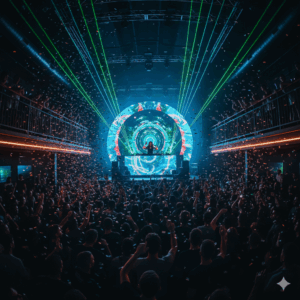
A smooth night comes from choosing one area (Shibuya, Roppongi, or Kabukicho/Shinjuku), then using official access/system pages to confirm walk times and entry rules.
If you want one phrase to remember, it’s tokyo dance clubs: plan your logistics first, then let the music do the rest.
Tokyo’s club scene is not random chaos—it’s an urban design. Many venues guide you through a controlled pathway: street queue, entrance staff, ID check, fee payment, wrist stamp, then a quick transition into a high-volume dance space. This is “institutionalized nightlife”: strangers can share close space safely because the rules and the architecture do a lot of social work. You don’t need perfect Japanese, but you do need to understand the system.
Inside, clubs often use zoning to manage comfort: a central dance floor for intensity, side rooms for genre changes, and calmer edges (bar counters, lounge corners, VIP tables). This zoning creates a structured form of temporary closeness—people move together to sound and light, then separate to breathe, talk, and reset.
The key practical point: age checks are strict. For example, WOMB states that standard “club time” events do not allow under-20 guests and require photo ID at the entrance:
WOMB FAQ (Japanese).
1. Where should you start when exploring tokyo dance clubs?
1-1 Choose a venue with an easy-to-read system
A beginner-friendly club is not just “famous”—it explains its entry system clearly. WOMB’s FAQ answers common questions like whether you can pay at the door (yes, unless an exception event), and it defines the “DOOR” price as the same-day entrance fee:
WOMB FAQ (Japanese).
This kind of clarity is what you want when you’re navigating a new nightlife culture.
1-2 Understand the “arrival choreography”
A good Tokyo club night starts before the first song you love. Expect a sequence: queue, ID check, entry payment, then a quick decision about your belongings. WOMB explains that it has coin lockers priced at ¥300 / ¥600 and a cloak service of ¥500 per bag:
WOMB FAQ (Japanese).
The conclusion is simple: you can dance more comfortably if you store your items early.
1-3 Decide your “comfort route” inside the club
Tokyo venues often provide multiple zones so you can control intensity. Plan your route: (1) first lap around the perimeter to understand exits and bar locations, (2) one set near the main floor center, and (3) a reset period at the edges. This is how the space “holds” a crowd without constant conflict—people can come close and step away without drama.
2. How do you access the best club areas in Tokyo?
2-1 Shibuya: dense streets and short hops between venues
Shibuya works well when you want flexibility: you can arrive early, adjust your plan, and still find food and trains easily. WOMB’s access page gives landmark-based directions—“walk up Dogenzaka for about 5 minutes,” then turn and go “about 50 meters” straight:
conclusion first (landmarks help at night), then numbers (~5 min + ~50 m), then source:
WOMB Access (Japanese).
2-2 Roppongi: quick station access and table-forward nightlife
Roppongi is often the easiest zone for “dress up, arrive, and enter quickly.” V2 TOKYO’s contact page states access from Roppongi Station exits is 徒歩1分 (1 minute walk) from both the Oedo Line (Exit 7) and Hibiya Line (Exit 4B):
V2 TOKYO Contact/Access (Japanese).
The conclusion: if you want minimal navigation stress, station-close venues are your friend.
2-3 Kabukicho/Shinjuku: big entertainment infrastructure
Kabukicho has a “city within a city” feeling at night, and some venues are built into large complexes. ZEROTOKYO’s access page lists walk times clearly:
Seibu-Shinjuku Station 1 min, Shinjuku Station 7 min, and Shinjuku-sanchome Station 8 min:
ZEROTOKYO Access (Japanese).
The conclusion: in Kabukicho, clear station benchmarks make planning easier even in crowded streets.
Table 1: Venue Types & Base Fees
| Venue Type | Typical Fee | Session Time | Area (JP Link) |
|---|---|---|---|
| Multi-floor music-focused club (Shibuya) | Conclusion: fees vary by event; check “DOOR” price on event page | Conclusion: event-based blocks (confirm schedule) | Official website (Japanese) |
| Large entertainment-complex club (Kabukicho) | Conclusion: cashless venue; prepare card/e-money/QR | Conclusion: event-based; confirm each listing | Official website (Japanese) |
| Mainstream single-floor dance club (Shibuya) | Conclusion: time-window pricing; example men ¥2,100/1D early and ¥3,600/1D late | Conclusion: late-night hours; example 22:00–4:30 | Official website (Japanese) |
| Table-forward “dress up” club (Roppongi) | Conclusion: weekend entry shown as ¥4,000 (2 drink tickets) | Conclusion: VIP seats are time-based; 2 hours per set | Official website (Japanese) |
Tokyo club fees are often “event pricing,” not a single fixed number. The best habit is to treat official pages as your final check on the day you go.
3. What do prices, hours, and entry rules look like?
3-1 Entry pricing: time windows and drink tickets
Conclusion: many clubs price by time window to shape crowd flow. Example: TK NIGHTCLUB TOKYO shows “Today’s Entrance Fee” with different prices for 22:00–24:00 and 24:00–4:30, including options like men ¥2,100/1D early and ¥3,600/1D late:
TK NIGHTCLUB TOKYO (Japanese).
Conclusion: in event-based clubs, you must read the event page. WOMB explains that you can pay at the door and that the event listing’s “DOOR” fee is the same-day entrance price:
WOMB FAQ (Japanese).
3-2 Hours: “late-night blocks” are normal
Conclusion: club hours are typically late, and some venues publish them plainly. TK NIGHTCLUB TOKYO lists an opening hour of 22:00–4:30:
TK NIGHTCLUB TOKYO (Japanese).
V2 TOKYO lists open time as 21:00–05:00:
V2 TOKYO Contact (Japanese).
3-3 ID checks and venue systems (cashless, lockers, re-entry)
Conclusion: bring photo ID and accept that checks are part of the standard flow. WOMB states standard club-time events do not allow under-20 guests and requires photo ID at entry (license, passport, etc.):
WOMB FAQ (Japanese).
Conclusion: some venues are fully cashless inside. ZEROTOKYO states it is a cashless venue (except coin lockers) and asks guests to prepare cards/e-money/QR payment:
ZEROTOKYO System (Japanese).
Table 2: Access & Hours
| Station | Walk Time | Hours | Area (JP Link) |
|---|---|---|---|
| Roppongi Station (Oedo Line Exit 7 / Hibiya Line Exit 4B) | Conclusion: station-close entry; 1 min from listed exits | Conclusion: late-night operations; 21:00–05:00 | Official website (Japanese) |
| Seibu-Shinjuku / Shinjuku / Shinjuku-sanchome | Conclusion: multiple station options; 1 min / 7 min / 8 min | Conclusion: event-based; confirm schedule | Official website (Japanese) |
| Shibuya (landmark route guidance) | Conclusion: landmarks beat GPS at night; ~5 min uphill + ~50 m straight | Conclusion: event-based; confirm each listing | Official website (Japanese) |
| Shibuya (TK NIGHTCLUB TOKYO) | Conclusion: easy address-based navigation; use official map link | Conclusion: stated hours; 22:00–4:30 | Official website (Japanese) |
If your goal is “more dancing, less walking,” choose venues with published walk times and hours on the official site.
4. Which venue types and music styles fit your night?
4-1 Music-forward clubs: the DJ booth is the “center of gravity”
Conclusion: if your priority is music discovery, pick clubs that emphasize programming and clear event listings. WOMB’s official calendar-based approach and FAQ language about “DOOR” fees show a strong event culture:
WOMB FAQ (Japanese).
In these spaces, the dance floor is a public commons; the crowd’s behavior is guided by sound, lighting, and entry routines rather than personal connections.
4-2 Entertainment-complex venues: the system is part of the experience
Conclusion: if you want a “big production” feeling, look for venues that publish detailed system rules. ZEROTOKYO explains cashless payment, notes dress expectations, and states that entry is for 20+ with ID checks:
ZEROTOKYO System (Japanese).
This kind of structure reduces uncertainty in a crowded nightlife environment.
4-3 Table-forward clubs: base-camp comfort and “night-out” style
Conclusion: if you want a predictable comfort zone (somewhere to sit, regroup, and store items), table culture matters. V2 TOKYO states VIP table reservations are 2 hours per set and that the set fee includes entry for up to a stated group size:
V2 TOKYO (Japanese).
This is less about “buying status” and more about organizing time and space in a busy venue.
5. How do reservations, etiquette, and Japanese phrases work?
5-1 Reservations: when you need them (and when you don’t)
Conclusion: you usually do not need a reservation to enter general admission unless the event says otherwise. WOMB explicitly states that you can pay the same-day fee at the entrance (with some exception events):
WOMB FAQ (Japanese).
Conclusion: VIP seating often benefits from advance booking. ZEROTOKYO provides an official VIP reservation route through TableCheck:
ZEROTOKYO VIP Reservation (Japanese).
5-2 Etiquette: dress, ID, and “quiet rules”
Conclusion: Tokyo clubs often say “no special dress code,” but still reserve the right to refuse outfits that don’t fit a public venue. WOMB notes that there is no special dress code, but staff may refuse clothing judged inappropriate; it also warns against beach sandals in some periods:
WOMB FAQ (Japanese).
Conclusion: prepare for system checks. ZEROTOKYO describes cashless payment and notes that ID checks are performed for all guests and that entry is 20+:
ZEROTOKYO System (Japanese).
5-3 Useful Japanese phrases: small words, big results
Conclusion: you don’t need fluent Japanese, but you do need a few “moment phrases” for entrance, lockers, and the bar. Keep them short and polite:
- At the entrance: 「身分証あります」(Mibunshō arimasu) = “I have my ID.”
- Door price: 「当日料金ですか?」(Tōjitsu ryōkin desu ka?) = “Is this the door price?”
- Lockers: 「ロッカーはどこですか?」(Rokkā wa doko desu ka?) = “Where are the lockers?”
- One drink: 「これをください」(Kore o kudasai) = “This one, please.”
- Water: 「お水ください」(Omizu kudasai) = “Water, please.”
- Thanks: 「ありがとうございました」(Arigatō gozaimashita) = “Thank you very much.”
Table 3: Reservation & Eligibility
| Method | Lead Time | Eligibility | Official (JP Link) |
|---|---|---|---|
| Walk-in (door payment) | Same day | Conclusion: standard club time is typically 20+ with photo ID | Official website (Japanese) |
| VIP reservation (online booking) | Book before your visit | Conclusion: follow booking instructions and venue policy | Official website (Japanese) |
| VIP tables (time-based sets) | Reserve for best selection | Conclusion: VIP is structured; 2 hours per set noted | Official website (Japanese) |
| Cashless preparation (some venues) | Before arrival | Conclusion: bring card/e-money/QR; cash not accepted inside (except lockers) | Official website (Japanese) |
“Reservation” in Tokyo clubs usually means VIP certainty, not basic entry. For general dancing, walk-in is common unless the event states otherwise.
6. Summary and Next Steps
Most visitors don’t struggle with the music—they struggle with the “system.” Tokyo club culture is friendly, but it is structured: ID checks, door pricing, drink tickets, lockers, cashless rules, and VIP tables that run on timed sets. When you’re new to tokyo dance clubs, small uncertainties add up fast: Which station exit matters? Is the door price different at midnight? Do you need cash, card, or QR? Can you re-enter? And which neighborhood actually fits your group—Shibuya’s dense streets, Roppongi’s dress-up energy, or Kabukicho’s big entertainment infrastructure?
SoapEmpire exists to reduce that friction. We translate nightlife logistics into a simple plan you can follow: choose an area, match your budget to a realistic entrance fee range, and confirm the official rules that matter most on the day you go. We also organize key choices—Shibuya for flexible venue-hopping, Roppongi for table-forward nights, and Kabukicho for large-scale experiences—so you can decide quickly without doom-scrolling dozens of pages.
Our strength is practical clarity in plain English. If you’re comparing entrance fee timing, VIP table options, and access routes, we summarize what to look for and how to read official pages correctly. If you want to reserve VIP or coordinate a group plan, we can help you do it smoothly—especially when booking tools and Japanese-only forms become a barrier. SoapEmpire covers major Japanese nightlife hubs nationwide, so your Tokyo plan can connect naturally to Osaka, Nagoya, or Fukuoka if your trip expands.
For related reading on SoapEmpire, you can start with How to Book in Japan, Tokyo Night District Overview, and Osaka Nightlife Guide. Learn more at SoapEmpire official website.
For reservations or inquiries, please contact us via the inquiry form.
6-1 A one-night plan you can copy
- Pick one area: Shibuya, Roppongi, or Kabukicho/Shinjuku.
- Open the venue’s official “Access” and “System/FAQ” pages and confirm the rules.
- Arrive early enough to learn the layout before peak crowd density.
- Use lockers/cloak immediately, then dance with fewer distractions.
Official starting points (Japanese): WOMB FAQ,
WOMB Access,
ZEROTOKYO System,
ZEROTOKYO Access,
TK NIGHTCLUB TOKYO,
V2 TOKYO Contact/Access.
6-2 What to carry (minimum kit)
- Valid photo ID (passport is the safest universal option).
- Payment method that matches the venue (cashless if stated).
- A compact bag that fits easily in lockers; keep it light.
6-3 Next reads on SoapEmpire
To deepen your plan (optional): How to Book, Tokyo Night District Overview, Osaka Guide.
FAQ
Q1. How much is entry for Tokyo dance clubs?
Conclusion: it depends on the venue and the time window. Example: TK NIGHTCLUB TOKYO publishes time-based entry like men ¥2,100/1D early and ¥3,600/1D late on its official page:
TK NIGHTCLUB TOKYO (Japanese).
For event-based venues, WOMB explains the “DOOR” fee on the event page is the same-day price:
WOMB FAQ (Japanese).
Q2. Do I need to book in advance?
Conclusion: general admission is often walk-in, but VIP tables commonly benefit from booking. ZEROTOKYO provides an official VIP reservation route here:
ZEROTOKYO VIP Reservation (Japanese).
Q3. What ID do I need, and what is the typical age rule?
Conclusion: many clubs require photo ID and typically restrict standard club time to 20+. WOMB states under-20 guests are not allowed for standard club time and lists acceptable IDs:
WOMB FAQ (Japanese).
Q4. Are Tokyo clubs cashless?
Conclusion: some venues are. ZEROTOKYO states it is a cashless venue (except coin lockers) and asks guests to prepare cards/e-money/QR payment:
ZEROTOKYO System (Japanese).
If you’re interested in visiting any of these places, SoapEmpire offers a 24-hour booking support service for only $10.
Just send the store name, preferred time, and your name (nickname is fine) to:
takuma@skylinks-inc.com.
We’ll take care of your reservation quickly and smoothly.