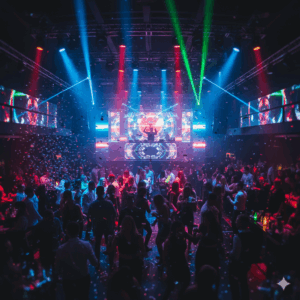
Tokyo dance clubs are a modern part of the city’s nighttime culture: tightly designed indoor spaces near major stations, with controlled entry lanes, coin lockers, and bright-to-dark “flow” that moves you from street to lobby to dance floor. Many venues use multi-floor layouts (main floor + lounge + VIP seating), which creates a clear social map: where you can dance, where you can talk, and where groups pay for table service.
Service is not “random nightlife.” It is structured: entry checks, ticket or door fee, a drink-ticket system, and then a shared floor where strangers coordinate distance, attention, and timing through music and crowd movement. In plain terms, the “experience” is produced by lighting, sound, queue management, and rules that keep the room comfortable. You don’t need perfect Japanese, but you do need a plan: ID, payment method, and a realistic budget.
1. Where should you start with Tokyo dance clubs?
1-1. Think “event night,” not “one fixed vibe”
Many Tokyo venues change their feel depending on the event: a techno night can be very different from an open-format hits night in the same building. Your first step is to open the official calendar and see what is actually happening on your dates. For example, WOMB’s calendar page lists dates, genres, and ticket links on the official site:
WOMB official calendar (Japanese).
If you want a big “festival inside a building” feeling, look at large venues in Roppongi or Shinjuku. If you want a club-culture feel that locals follow by genre, Shibuya has long-running venues with more variety night-to-night (including techno, hip-hop, and mixed events).
1-2. Understand the standard entry flow (it reduces stress)
Tokyo clubs are designed for smooth movement: queue → ID check → payment → drink ticket(s) → coin locker/cloak → floor. If you know this flow, you will feel comfortable even if you arrive alone. WOMB explains that you can pay the door price at the entrance (and that the event page shows the “DOOR” price), which is helpful if you did not buy a ticket online:
WOMB FAQ (Japanese).
Another modern pattern is cashless-only operation inside the venue (except coin lockers). ZEROTOKYO states that it is a cashless venue for in-club payments and asks guests to prepare cards/e-money/QR payments:
ZEROTOKYO system page (Japanese).
1-3. Entry rules are part of the “comfort design”
Tokyo clubs often communicate rules very directly: age limits, photo ID checks, and basic dress expectations (especially footwear). This is not about being “exclusive” for its own sake; it is a way to keep the room’s mood stable and predictable. clubasia’s access page, for example, states that under-20 entry is not allowed for night events and asks for photo ID at entry:
clubasia access & entry notes (Japanese).
2. Which areas are best, and how do you access them?
2-1. Shibuya: high density, many styles in walking range
Shibuya concentrates clubs close to the station, so you can “try one place and move” without long travel. WOMB is near Dogenzaka and gives a clear walking description from the Shibuya 109 area, including “about 5 minutes” up the slope and then a short side street:
WOMB access (Japanese).
For a large mixed-music floor, TK NIGHTCLUB posts its base opening hours and entrance-fee time windows on the official site:
TK NIGHTCLUB official site (Japanese).
For older “club + live house” style programming, clubasia has long history in Shibuya and posts access and entry notes here:
clubasia access (Japanese).
2-2. Roppongi: big venues, strong VIP/table culture
Roppongi has a well-known pattern: large venues, strong production (sound/light), and a clear VIP/table layer. V2 TOKYO publishes its access from Roppongi Station as “1 minute” from specific exits and lists opening hours on its official contact page:
V2 TOKYO contact & access (Japanese).
If you prefer minimal walking and a “one building does everything” approach, Roppongi is efficient: arrive, enter, lock your bag, then choose between the main floor and lounge spaces.
2-3. Shinjuku (Kabukicho): entertainment complex style
Shinjuku’s Kabukicho area has developed into a concentrated entertainment zone with large-scale indoor facilities. ZEROTOKYO lists walk times from major stations on its official access page: 1 minute from Seibu-Shinjuku, 7 minutes from JR Shinjuku, and 8 minutes from Shinjuku-sanchome:
ZEROTOKYO access (Japanese).
This “tower/complex” format changes how the night feels: fewer small street-to-street moves, more time inside a controlled environment with multiple floors and zones.
*Table 2: Access & Hours*
| Station | Walk Time | Hours | Area (JP Link) |
|---|---|---|---|
| Roppongi Station → V2 TOKYO | 1 min | 21:00–05:00 | Official website (Japanese) |
| Shinjuku / Seibu-Shinjuku → ZEROTOKYO | 1–8 min (by station) | Varies by event (check schedule) | Official website (Japanese) |
| Shibuya 109 area → WOMB | ~5 min up Dogenzaka (then short side street) | Event-led (check calendar) | Official website (Japanese) |
| Shibuya → TK NIGHTCLUB | (See map on official site) | 22:00–04:30 | Official website (Japanese) |
| Shibuya → OR TOKYO (MIYASHITA PARK) | (Inside MIYASHITA PARK) | Mon–Sat 11:00–05:00 (Sun 11:00–24:00) | Official website (Japanese) |
Numbers are taken from each venue’s official access/contact pages. When hours are “event-led,” check the official calendar or event page before you go.
3. What should you expect to pay, and who can enter?
3-1. Entry fees: “weekday vs weekend” is the simplest rule
A clear example is V2 TOKYO’s published entrance-fee system. It states that on weekdays, men are ¥2,000 with 1 drink ticket, and women have free admission; on weekends, men are ¥4,000 with 2 drink tickets, and women remain free (with notes that special events may change pricing):
V2 TOKYO entrance fee system (Japanese).
TK NIGHTCLUB shows time-window pricing (earlier is cheaper). For example, it lists men at ¥500 (early) on weekdays, and higher later-night pricing on weekends (with drink-ticket bundles):
TK NIGHTCLUB entrance fee listing (Japanese).
3-2. Event-based pricing: look for “DOOR” on the event page
Some venues price by event rather than by a fixed weekly system. WOMB’s FAQ explains that you can enter by paying the same-day price at the entrance and that the event page shows the “DOOR” fee:
WOMB FAQ about door fee (Japanese).
A concrete example is a WOMB event page that lists time and door price together: 23:00–4:30 and DOOR: ¥5,500 for that specific night:
WOMB event page example (Japanese).
This is why “check the official schedule” is the best advice: it prevents surprise costs.
3-3. Eligibility: age limits, ID checks, and payment methods
Many Tokyo dance clubs clearly state age limits for late-night entry. ZEROTOKYO’s rules state entry is from age 20 and that all guests are checked with acceptable photo IDs:
ZEROTOKYO rules & ID check (Japanese).
OR TOKYO also states “You must be over 20 with photo ID” in its access section:
OR TOKYO access notes (Japanese).
Payment is also part of eligibility in a practical sense. ZEROTOKYO states it is cashless inside the venue (except coin lockers), so plan your payment method in advance:
ZEROTOKYO cashless policy (Japanese).
If you prefer cash, choose venues that accept cash at entry (many do), or confirm the policy before you go.
*Table 1: Venue Types & Base Fees*
| Venue Type | Typical Fee | Session Time | Area (JP Link) |
|---|---|---|---|
| Mega club (Roppongi) | Men ¥2,000 (weekday) / ¥4,000 (weekend); Women free (base system) | 21:00–05:00 | Official website (Japanese) |
| Large mixed floor (Shibuya) | Time-window pricing; example men from ¥500 (early) with drink bundle | 22:00–04:30 | Official website (Japanese) |
| Event-led club culture (Shibuya) | Varies by event; check “DOOR” on the official event page | Common late-night window; example 23:00–4:30 on an official event listing | Official website (Japanese) |
| Entertainment complex (Shinjuku) | Event-led; venue notes include cashless inside (except lockers) | Varies by event (confirm schedule) | Official website (Japanese) |
| Hybrid music bar / event space (Shibuya) | Event-dependent (often listed per event) | Mon–Sat 11:00–05:00 | Official website (Japanese) |
“Typical Fee” reflects what each venue publishes as its base system or event listing. Special events can change prices, so always verify on the official page.
4. What venue types and “services” shape the night?
4-1. Mega clubs: VIP tables are a parallel experience
In big venues, VIP tables are not just “better seats.” They are a structured package: entry included for a set number of people, a time limit, and a required bottle order. V2 TOKYO lists VIP table pricing with weekday/weekend differences (and notes a service charge), which shows how formalized this layer is:
V2 TOKYO VIP table pricing (Japanese).
This matters culturally because it shapes how groups socialize: table zones support longer conversations and “hosting,” while the main floor supports anonymous movement and shared rhythm. You can still have a great night without VIP, but understanding the structure helps you read the room.
4-2. Event-led clubs: genre communities and repeat nights
Shibuya has venues where the identity is strongly tied to the event calendar: techno-focused nights, label showcases, and themed parties. WOMB’s official event pages list genre tags and time/door price per night:
WOMB events (Japanese).
The “service” here is curation: booking DJs, setting a sound profile, and building a repeat audience. For visitors, the practical takeaway is simple: pick your genre first, then pick the venue that is hosting it that night.
4-3. Hybrid venues: music + bar + culture programming
Some places blend a club feel with a music bar, cafe, or event space. OR TOKYO describes itself as a multi-floor entertainment facility inside MIYASHITA PARK (with different floors and programming), which makes it useful if your group wants a softer start before a later club peak:
OR TOKYO official site (Japanese).
These hybrids are also friendly for visitors who want clear signage and a “layered” night: you can talk first, then dance, then return to a quieter zone. In terms of urban nightlife design, this is a controlled way to manage energy across several hours.
5. How do reservations, etiquette, and phrases work in practice?
5-1. Tickets vs door payment: what to do if you didn’t plan ahead
Many visitors worry that they “must” buy tickets online. In practice, some clubs make it clear that door payment is possible. WOMB’s FAQ says you can pay the same-day door fee at the entrance (with exceptions for some events) and that the event page shows the “DOOR” fee:
WOMB FAQ (Japanese).
If you are going to a large venue with a published fee system, you can often decide at the door. For time-window pricing (cheaper early), TK NIGHTCLUB’s official page lists the early/late entrance fee windows:
TK NIGHTCLUB system (Japanese).
5-2. Reservations: VIP tables and “supported entry”
VIP is where reservations matter most. Camelot publishes VIP plans with weekday prices like ¥40,000 (plan example) and weekend higher tiers, along with a typical 2-hour set structure:
CLUB CAMELOT VIP plans (Japanese).
V2 TOKYO also publishes VIP table prices by area and day:
V2 TOKYO VIP info (Japanese).
ZEROTOKYO’s VIP page explains that VIP bookings can be done via event pages, phone, or LINE, and it lists a phone number plus a booking-time window (Wednesday–Sunday, 20:00–26:00):
ZEROTOKYO VIP booking methods (Japanese).
*Table 3: Reservation & Eligibility*
| Method | Lead Time | Eligibility | Official (JP Link) |
|---|---|---|---|
| Door payment (general entry) | Same day | Photo ID required; night events often age 20+ | Official website (Japanese) |
| Time-window entry system | Arrive early for lower fees | Bring ID; plan budget for later peak time | Official website (Japanese) |
| VIP table booking (package) | Same day to several days (recommended) | Often 2-hour set; bottle order requirements (see venue) | Official website (Japanese) |
| Cashless venue policy | Prepare before arrival | Bring card/e-money/QR payment; ID check (age 20+) | Official website (Japanese) |
“Lead time” depends on the night. For busy weekend events, VIP reservations are best done earlier. Always confirm the official system page for payment rules (including cashless policies).
5-3. Etiquette and useful Japanese phrases (plain and practical)
Etiquette in Tokyo clubs is mostly about not creating friction: queue calmly, have your ID ready, use the locker if you have a big bag, and follow simple footwear guidance. Some venues explicitly note footwear restrictions (especially sandals) on official pages, such as clubasia’s entry notes:
clubasia access notes (Japanese).
Camelot also notes footwear restrictions in its official help page:
CAMELOT dress code note (Japanese).
*Table 4: Useful Phrases Quick Ref*
| Situation | Japanese | Plain English | Official (JP Link) |
|---|---|---|---|
| At the entrance | 「入れますか?」(Ire-masu ka?) | “Can I enter?” | Official website (Japanese) |
| ID check | 「パスポートあります」(Pasupooto arimasu) | “I have my passport.” | Official website (Japanese) |
| Cashless confusion | 「カードで払えますか?」(Kaado de harae-masu ka?) | “Can I pay by card?” | Official website (Japanese) |
| Locker/cloak | 「ロッカーはどこですか?」(Rokkaa wa doko desu ka?) | “Where are the lockers?” | Official website (Japanese) |
These phrases are intentionally short. Staff are used to quick exchanges at entry and bar counters, especially during peak hours.
6. Summary and Next Steps
Visiting tokyo dance clubs is exciting, but most first-time visitors run into the same problems: you arrive at the wrong time window, you don’t know whether the night is ticket-based or door-based, and you are unsure about payment rules (especially at cashless venues). Tokyo’s club scene is event-led, and the details change by day—so “just showing up” can work, but it often wastes time and budget.
SoapEmpire helps you solve this with a simple approach: we match your goals (music style, neighborhood, and comfort level) to the right plan for the night. If you want Shibuya clubs with variety, we’ll point you to the best event pages and entry systems. If you prefer Roppongi nightlife with a dress-up feel, we’ll help you read the entrance fee system and decide whether VIP tables make sense for your group. If you’re aiming for a high-production, complex-style night in Shinjuku, we’ll highlight practical issues like cashless entry and walk-time convenience so you’re not surprised at the door.
Our strength is clarity. We organize official information (fees, hours, access, and eligibility) into plain English and give you a step-by-step plan—without hype and without confusion. We also cover the basics that matter on the street: what to prepare for ID checks, how to time your arrival, and what simple Japanese phrases reduce friction. Whether your focus is techno events, a mixed-music crowd, or VIP tables, you get one consistent roadmap for the night.
If you want extra support, SoapEmpire offers a 24-hour booking support service for only $10. That is especially useful when you need help with a VIP reservation request, a specific arrival time, or a group plan that needs confirmation. You enjoy the night; we handle the “small logistics” that can cause the biggest headaches.
For reservations or inquiries, please contact us via the inquiry form.
6-1. A simple 5-step plan for your night
- Pick an area: Shibuya (variety), Roppongi (big-room + VIP), or Shinjuku (complex-style).
- Open the official schedule/system page and confirm the fee style.
- Prepare photo ID (and confirm age policy where stated, often 20+).
- Decide entry style: door/ticket, or VIP/table (book earlier for weekends).
- Arrive with a realistic budget and a plan for late-night movement.
Official starting points: WOMB calendar, V2 TOKYO system, ZEROTOKYO access, TK NIGHTCLUB system.
6-2. SoapEmpire internal guides you can read next
- Tokyo Nightlife Guide (SoapEmpire)
- Shibuya Nightlife Guide (SoapEmpire)
- Roppongi Nightlife Guide (SoapEmpire)
- How to Book in Japan (SoapEmpire)
You can also visit our official site here: SoapEmpire.
6-3. FAQ (plain English)
Q1. How much is the entry fee at Tokyo dance clubs?
It depends on the venue and the night. Some clubs publish a base system (for example, V2 TOKYO lists men at ¥2,000 on weekdays and ¥4,000 on weekends in its entrance fee system: Official website (Japanese)). Others are event-led, so you should check the event page “DOOR” price (for example, WOMB event pages can show door fees like ¥5,500: Official website (Japanese)).
Q2. Do I need to book in advance?
Not always. Some venues allow door payment on the night, and WOMB explains that you can pay the door fee at the entrance (with some event exceptions): Official website (Japanese). VIP tables are different—those often require a reservation plan (see VIP pages like Official website (Japanese)).
Q3. Can I go if I don’t speak Japanese?
Yes—many processes are simple and standardized (queue, ID check, payment, drink ticket). The key is preparation: bring photo ID, and confirm the system rules. For example, ZEROTOKYO explains cashless payment inside and ID checks on its system page: Official website (Japanese). A few short phrases (like “Can I pay by card?”) also help.
If you’re interested in visiting any of these places, SoapEmpire offers a 24-hour booking support service for only $10.
Just send the store name, preferred time, and your name (nickname is fine) to:
artistatakuma@icloud.com.
We’ll take care of your reservation quickly and smoothly.