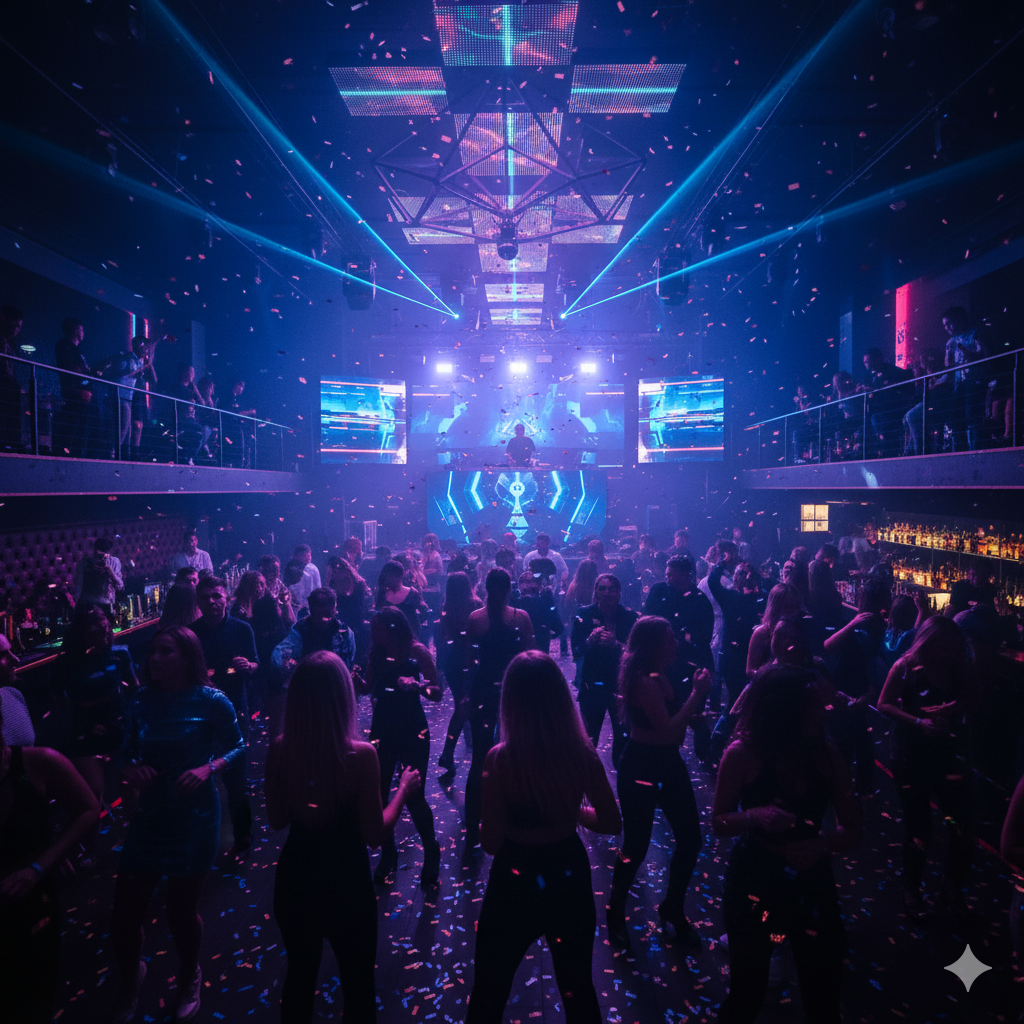
In Kabukicho, large venues can feel like entertainment hubs with multiple floors and clear entry systems; in Ni-chome, party nights are often community-forward and event-based.
This guide explains access, typical entry fees, eligibility, and etiquette in plain English—with primary links so you can verify details on the day you go.
A modern Shinjuku dance club night is built around managed flow: an entrance queue, an ID check, a predictable fee structure (often “entry + 1 drink”), and then movement across dance floors, bars, and (sometimes) table sections. The “service” here is not mysterious—music programming, lighting, staff-managed pacing, and structured personal space (lockers, cloak, VIP zones) that let a dense crowd remain navigable.
From an ethnographic angle, Shinjuku’s dance spaces work as “institutionalized intimacy”: proximity is staged through sound, light, and choreography (where you stand, how you move, how long you stay), while rules keep the room legible (ID checks, no-photo policies, and entry bands). The result is a nightlife ecosystem where strangers can share a night smoothly—without needing deep local knowledge.
1. Where should you start in shinjuku dance club culture?

1-1. Kabukicho vs Ni-chome: two different “night maps”
Kabukicho is Shinjuku’s entertainment grid: short blocks, bright signage, and venues that are designed to absorb high foot traffic. If you want a big-room feel, start around Tokyu Kabukicho Tower, where ZEROTOKYO is positioned as a night entertainment anchor (ZEROTOKYO official “About” (Japanese); also listed on Tokyu Kabukicho Tower floor/club page (Japanese)).
Ni-chome (near Shinjuku-sanchome) is often more event-forward: the “night” is shaped by what is happening on that date, and the room can change character dramatically across different parties. For a clear example of event-led programming, see AiSOTOPE LOUNGE official site (Japanese).
1-2. Music programming and crowd flow: what changes your experience
In Shinjuku, “what night is it?” matters more than “what venue is it?” Large clubs may run different floors or time blocks, while event venues flip their crowd profile based on the booking. A practical move is to check the venue’s official system page and calendar the same day you go. For example, WARP publishes time-based admission bands on its official system page (WARP SHINJUKU system/admission (Japanese)).
1-3. A typical “first-timer” night: the standard choreography
Most first-timer nights follow a predictable choreography: queue → ID check → entry fee (often with 1 drink) → locker/cloak → main floor → bar breaks → (optional) second floor or lounge area → exit. This is why Shinjuku feels “doable” even when it’s crowded: the steps are institutionalized, and the venue layout is designed to reduce confusion.
2. How do you access top areas for late-night clubbing?

2-1. Kabukicho core: Tokyu Kabukicho Tower and nearby clubs
If your plan includes ZEROTOKYO, its official access page gives the most useful “minutes” list for a visitor: 1 minute from Seibu-Shinjuku Station, 7 minutes from Shinjuku Station, and 8 minutes from Shinjuku-sanchome Station (ZEROTOKYO access (Japanese)).
As a landmark, Tokyu Kabukicho Tower is also an easy mental anchor when you are walking at night (Tokyu Kabukicho Tower “ZEROTOKYO” page (Japanese)).
2-2. WARP SHINJUKU: using the official address to reduce wandering
WARP SHINJUKU publishes a precise address on its official site (Kabukicho 1-21-1-B1). If you set the destination exactly as written, you reduce last-minute “which building?” confusion (WARP SHINJUKU official top/access block (Japanese) or WARP SHINJUKU access page (Japanese)).
2-3. Ni-chome: Shinjuku-sanchome is the practical station choice
For Ni-chome party venues, Shinjuku-sanchome is usually the easiest navigation point. AiSOTOPE LOUNGE lists 3 minutes from Shinjuku-sanchome Station (C8 exit), and 15 minutes from JR Shinjuku Station East Exit (AiSOTOPE LOUNGE access (Japanese)).
Table 2: Access & Hours
| Station | Walk Time | Hours (typical) | Area (JP Link) |
|---|---|---|---|
| Seibu-Shinjuku Station → ZEROTOKYO | 1 min | Event-based (check schedule) | Official website (Japanese) |
| JR Shinjuku Station → ZEROTOKYO | 7 min | Event-based (check schedule) | Official website (Japanese) |
| Shinjuku-sanchome Station (C8) → AiSOTOPE LOUNGE | 3 min | Event-based (example: 22:00–5:00) | Official website (Japanese) |
| JR Shinjuku Station East Exit → AiSOTOPE LOUNGE | 15 min | Event-based (check schedule) | Official website (Japanese) |
Walk times are taken from each venue’s official access page. “Hours” can change by event, so treat the time range as an example and confirm on the official schedule before you go.
3. What do prices, time, and eligibility look like?

3-1. Admission fees: “entry + 1 drink” is a common format
Many Shinjuku clubs publish a clear “entry fee + 1 drink” style. WARP SHINJUKU shows a time split (Sun–Thu): ¥1,000/1D for men before midnight and ¥2,500/1D after midnight, with women listed as ¥800/1D (WARP SHINJUKU system/admission (Japanese)).
ATOM SHINJUKU publishes a “happy hour → regular hours” structure: for example, it lists free entry early, then ¥1,900 (men) and ¥900 (women) later on many nights, and higher men’s fees on Fri/Sat regular hours (ATOM SHINJUKU official top/price block (Japanese)).
For event-led venues, the cleanest pricing source is the event detail page itself. AiSOTOPE’s event listing can show door prices like ¥3,500/1D for a specific night (AiSOTOPE event detail example (Japanese)).
3-2. Time: plan your night around “start time,” not just “closing time”
Shinjuku dance nights often “turn on” after a certain hour. WARP’s official fee bands show how the night is structured by time (e.g., a price change after midnight) (WARP SHINJUKU system/admission (Japanese)). AiSOTOPE event pages list explicit open times (example: 22:00–5:00) (AiSOTOPE event detail example (Japanese)).
3-3. Eligibility and payment: ID checks and (sometimes) cashless rules
Eligibility is typically straightforward: venues often require age 20+ and a photo ID check. ATOM SHINJUKU states that entry is for 20+ and that ID checks are performed at entry (ATOM SHINJUKU official “Attention” block (Japanese)). AiSOTOPE likewise requires photo ID and states no entry for under 20 on its official page (AiSOTOPE LOUNGE official rules block (Japanese)).
Table 1: Venue Types & Base Fees
| Venue Type | Typical Fee | Session Time | Area (JP Link) |
|---|---|---|---|
| Large-scale entertainment club (Kabukicho) | Varies by event (check official system/FAQ) | Event-based | Official website (Japanese) |
| Multi-floor nightclub with time-banded entry (Kabukicho) | Men: ¥1,000/1D (before midnight, Sun–Thu) / ¥2,500/1D (after) | Until 04:30 (see system) | Official website (Japanese) |
| High-rise club with “happy hour” (Shinjuku) | Example: Men ¥1,900 / Women ¥900 (time-dependent) | Example: 22:00–04:30 (see official) | Official website (Japanese) |
| Event-led party venue (Ni-chome) | Example door: ¥3,500/1D (event-specific) | Example: 22:00–05:00 (event-specific) | Official website (Japanese) |
Fees in yen are pulled from official “system,” “price,” or “event detail” pages. When a venue is event-based, the most accurate price is the specific event listing for that date.
Table 3: Reservation & Eligibility
| Method | Lead Time | Eligibility | Official (JP Link) |
|---|---|---|---|
| Walk-in entry (door fee) | Same day (event-dependent) | Photo ID required; typically 20+ | Official website (Japanese) |
| Cashless policy confirmation | Before arrival | Bring card/e-money/QR payment | Official website (Japanese) |
| Event-specific entry (ticket/door details) | By event (check detail page) | Photo ID required; under-20 not admitted | Official website (Japanese) |
| Entry rules & ID checks (explicit) | Before arrival | Entry is 20+; ID check at the door | Official website (Japanese) |
This table focuses on rules you can confirm directly from official pages (ID, age, payment style, and event detail formats).
4. Which venue types and services fit your Tokyo dance floor style?

4-1. Kabukicho “superclub” style: entertainment junction logic
ZEROTOKYO describes itself as a Shinjuku Kabukicho night entertainment facility with an “ENTERTAINMENT JUNCTION” concept—think of it as a venue designed for multiple kinds of entertainment content to intersect (music, space design, and performance) (ZEROTOKYO official “About” (Japanese)).
The practical meaning for visitors is simple: the room is built to guide you—clear zones, strong production, and a “system/FAQ” structure that tells you how entry and rules work (ZEROTOKYO FAQ (Japanese)).
4-2. Multi-floor variety nights: why time bands matter
WARP SHINJUKU frames its nightlife as a platform where you can enjoy different music/event experiences across separated floors (WARP SHINJUKU official description (Japanese)). The key visitor advantage is predictability: their system page shows time-sliced entry fees, which signals how the venue expects the crowd to change through the night (WARP SHINJUKU system/admission (Japanese)).
4-3. Event-led rooms in Ni-chome: “the venue is the calendar”
In Ni-chome, the “service” is the event itself: genre, crowd mix, door fee, and open time are posted per night. AiSOTOPE event pages list a full information block (restriction type, open time, fee, genre) so you can plan without guessing (AiSOTOPE event detail example (Japanese)).
Table 4: Venue “feel” quick map (practical choices)
| If you want… | Pick this structure | What to check | Official (JP Link) |
|---|---|---|---|
| High production + landmark venue | Kabukicho entertainment hub | Access minutes + cashless policy | Official website (Japanese) |
| Variety night + time-based crowd shift | Multi-floor nightclub | Entry fee time bands (before/after midnight) | Official website (Japanese) |
| Event-led party energy | Calendar-driven venue | Door fee + open time on event page | Official website (Japanese) |
This is a planning table: it tells you which official page to open first, so you can verify the details that actually change your night.
5. How do reservations, etiquette & useful phrases work?

5-1. Walk-in vs ticketed: how to decide in 30 seconds
If a venue is event-led (calendar-driven), the cleanest “reservation” is often simply knowing the event detail page: it tells you open time and door fee. AiSOTOPE publishes event info blocks including fee and open time (AiSOTOPE event detail example (Japanese)).
If a venue is system-driven (time-banded entry), your best prep is reading the official system page so you know what the fee is at your arrival time (WARP SHINJUKU system/admission (Japanese)).
5-2. VIP and reservations: what “booking” means at clubs
“Reservation” in dance clubs usually means a table or VIP seating plan (not general entry). WARP’s official site shows VIP reservation options on the top page (WARP SHINJUKU official VIP reservation area (Japanese)). ATOM SHINJUKU also presents a reservation flow and notes that reservations have time rules (for example, being treated as cancelled after a set time past your reservation) (ATOM SHINJUKU official reservation notes (Japanese)).
5-3. Etiquette and useful phrases: keep the room comfortable
Etiquette is mainly about respecting the venue’s posted rules. For example, AiSOTOPE explicitly states “No photo or video shooting without permission” and “No drink or food to bring in” on its official site (AiSOTOPE LOUNGE official rules block (Japanese)). Many clubs also ask for photo ID at entry (see: ATOM SHINJUKU official “Attention” block (Japanese)).
Table 5: Useful Phrases Quick Ref
| Situation | Japanese | Plain English meaning | Official (JP Link) |
|---|---|---|---|
| At the door (ID check) | 身分証あります(みぶんしょう あります) | “I have my ID.” | Official website (Japanese) |
| Ask the fee | 入場料はいくらですか?(にゅうじょうりょう は いくら ですか) | “How much is the entry fee?” | Official website (Japanese) |
| Lockers/cloak | ロッカーはありますか?(ろっかー は ありますか) | “Do you have lockers?” | Official website (Japanese) |
| Confirm no-photo rule | 写真はだめですか?(しゃしん は だめ ですか) | “Is photography not allowed?” | Official website (Japanese) |
The best phrases are short and functional. Use them with a calm tone and a small bow; it signals respect and usually improves the interaction immediately.
6. Summary and Next Steps
6-1. Two simple itineraries you can actually follow
Itinerary A (Kabukicho, big-room focus): Start near Seibu-Shinjuku → head to Tokyu Kabukicho Tower area → use ZEROTOKYO’s access minutes (official access) to time your walk → check cashless policy (official system) before you leave.
Itinerary B (Ni-chome, event-led focus): Start at Shinjuku-sanchome (C8) → walk 3 minutes to AiSOTOPE (official access) → open the specific event page for fee and time (example: event detail).
6-2. Budget and preparation checklist (the essentials)
- Photo ID (many venues explicitly require it; examples include ATOM SHINJUKU and AiSOTOPE).
- Entry budget: common bands like ¥1,000–¥4,000 appear on official system pages (example: WARP SHINJUKU system).
- Payment prep: some venues specify cashless rules (example: ZEROTOKYO system).
6-3. Read more on SoapEmpire (internal guides)
If you want a broader “city map” view (including how Shinjuku differs from Shibuya and Roppongi), these internal SoapEmpire guides help you plan faster:
- Shinjuku nightlife district guide
- Clubs in Tokyo Japan: how to plan a smooth night out
- Tokyo dance clubs: a practical first-timer guide
For neighborhood context, you can also browse Kabukicho Official Portal Site (Japanese) and Shinjuku-wide visitor information at Shinjuku Convention & Visitors Bureau (Japanese).
Planning a shinjuku dance club night sounds simple—until you hit the real friction points: the fee changes by time or event, the most important rules are posted in Japanese, and you only realize a venue is cashless (or ID-strict) when you are already at the door. That gap is exactly where SoapEmpire helps. We take the things that actually change your experience—access minutes, entry systems, eligibility rules, and reservation options—and rewrite them in plain English so you can make a clean plan in minutes instead of doom-scrolling.
Think of Shinjuku nightlife as two engines running side by side: Kabukicho’s high-output entertainment zones (Shinjuku nightclub scale, multi-floor pacing, big DJ events) and Ni-chome’s calendar-driven party nights (community energy, specific door fees, explicit open/close windows). If you do not match your plan to the right engine, the night can feel confusing—arriving too early for the vibe you want, walking to the wrong station exit, or choosing a venue that does not match your budget. SoapEmpire organizes those decisions around the practical questions travelers ask: “Where do I start?”, “How long is the walk from the station?”, “What is the real entry fee at my arrival time?”, and “What do I need to show at the door?”
Our advantage is clarity plus coverage. We summarize the key options across Tokyo’s main nightlife zones (including Shinjuku) and translate venue systems into quick checklists: what to prepare, what to expect, and how to avoid accidental mismatches. We also highlight details that visitors miss, like time-banded pricing, event-only doors, and cashless policies—so your “Tokyo dance floor” night feels smooth rather than stressful. And if you want to remove uncertainty completely—especially for VIP seating, group nights, or specific time slots—SoapEmpire can coordinate reservations for you. We offer 24-hour booking support for a fixed $10, so you can send a store name and time, then let us handle the back-and-forth in Japanese when needed.
The result is simple: less guessing, fewer dead ends, and more time actually enjoying the music. For reservations or inquiries, please contact us via the inquiry form.
FAQ
If you’re interested in visiting any of these places, SoapEmpire offers a 24-hour booking support service for only $10.
Just send the store name, preferred time, and your name (nickname is fine) to:
artistatakuma@icloud.com.
We’ll take care of your reservation quickly and smoothly.